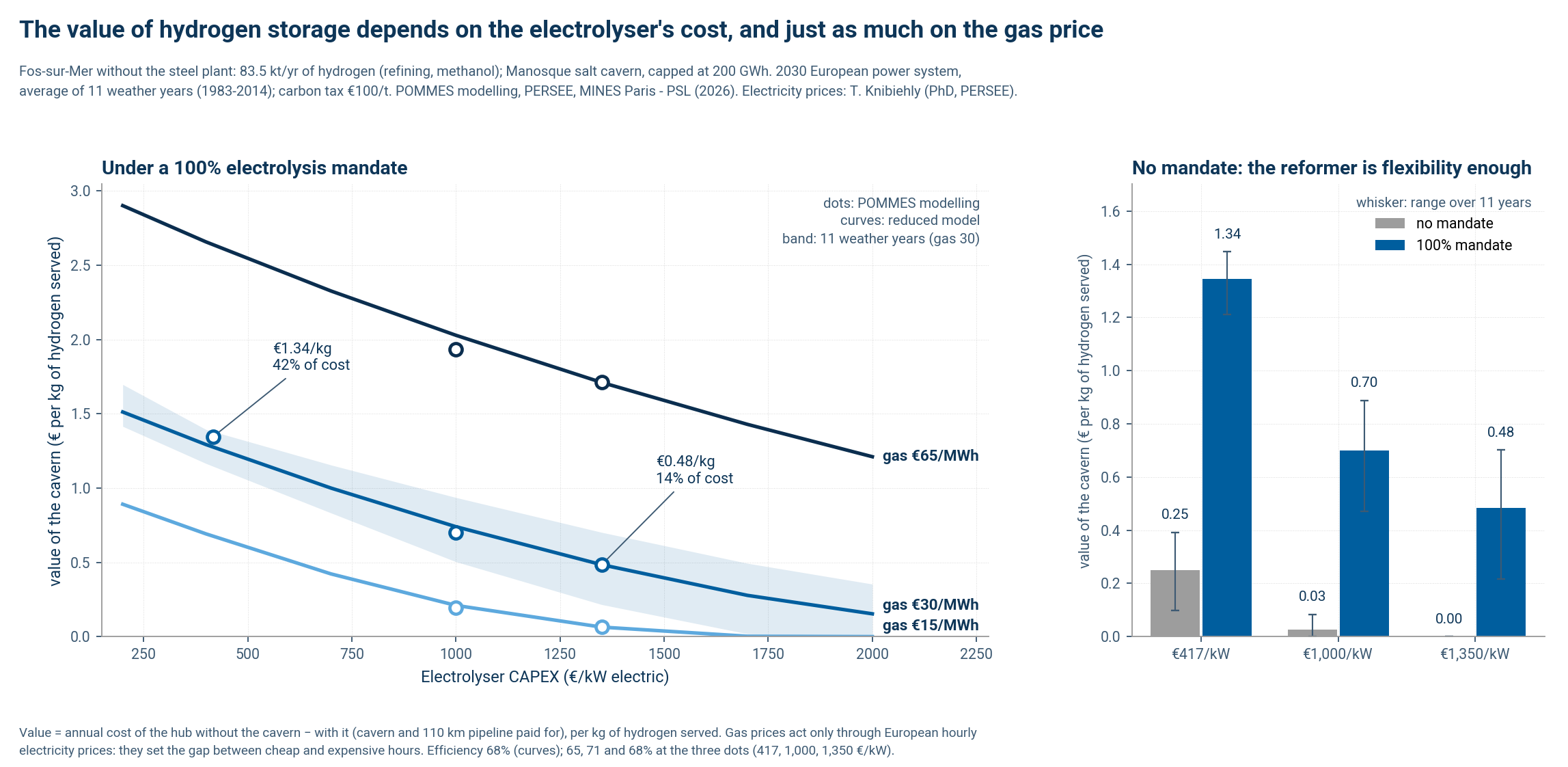
The Fos-sur-Mer industrial zone uses 83.5 kt of hydrogen a year (refining, methanol), made today by a natural-gas reformer, plus some by-product hydrogen from the chlorine plant. An electrolyser could make it instead, buying electricity at the hourly price. Two questions:
- What is a hydrogen storage worth — the Manosque salt cavern, 110 km away — to that electrolyser, and how does that value depend on its investment cost (CAPEX)?
- What does it cost to do without the gas reformer as a back-up, i.e. to impose 100 % electrolytic hydrogen?
Hourly French electricity prices come from a POMMES model of the 2030 European power system (11 weather years, three gas prices; PhD of Thibaut Knibiehly, PERSEE). The hub itself is a one-node hourly linear programme, the reduced model, which chooses the electrolyser and cavern sizes and their hourly operation at least annual cost. It reproduces the full POMMES modelling of Fos at every point POMMES solved.
The interactive page
Choose the electrolyser CAPEX, the gas price (it sets the spread between expensive and cheap hours), the hydrogen volume and the cavern cap: the value of storage reads in €/kg, on average and for each of the 11 weather years. The second part imposes a growing share of electrolysis and shows the extra cost against the unconstrained hub. The sliders read grids precomputed by the reduced model; nothing is recomputed in the browser.
Open the interactive page in its own tab
The notebook
The full story, executed with its outputs: hourly prices, one run of the reduced model step by step, the check against the POMMES modelling, the two questions, a simplified rule that needs no solver, and what the case does not say.
download the .ipynb · see it on GitLab
Figures
What the case does not say
- Electricity prices are exogenous: the electrolyser does not move them.
- The cavern is capped at 200 GWh, a declared and not a geological cap: the value is a lower bound.
- Fos is an isolated node: a hydrogen network (to Lyon, Spain) would change the value of local storage.
- The EU hourly-correlation rule for renewable hydrogen (RFNBO) is not modelled.
- One power system (2030): the weather years change, the fleet does not. Replaying the case with the TYNDP 2026 scenarios is the natural next step.
Posts about it
Data
- donnees_valeur_stockage_pommes.csv — value of the cavern in the POMMES modelling, by CAPEX, gas price and mandate: mean, minimum and maximum over the 11 years.
- donnees_valeur_stockage_modele_reduit.csv — the same value in the reduced model, by CAPEX (200 to 2,000 €/kW), gas price, hydrogen volume and cavern cap.
- hypotheses.yaml — every assumption of the case: value, unit, source, status.
Code
The code, the frozen data and the assumptions are in the public repository pommes-case-studies.
To redo everything:
git clone https://git.persee.minesparis.psl.eu/energy-alternatives/pommes_studies/pommes-case-studies.git
git clone --branch regles-gelees-v2-2026-10-03 https://git.persee.minesparis.psl.eu/energy-alternatives/regles_parametriques.git
export REGLES_PARAMETRIQUES=$PWD/regles_parametriques OMP_NUM_THREADS=1
cd pommes-case-studies/cas_fos_h2_stockage
python grille.py stockage && python grille.py hybride   # le modèle réduit (HiGHS ; --solveur gurobi plus rapide)
python analyse.py && python figures.py && python build_page.py
jupyter nbconvert --to notebook --execute --inplace notebook.ipynb
The equations and costs of the reduced model are in the public module regles_parametriques; the case calls them without copying them.
Sources
- POMMES, code source (GitLab PERSEE)
- The case: code, frozen data, assumptions (pommes-case-studies)
- Parametric rules: the reduced model and its costs (tag regles-gelees-v2-2026-10-03)
- MINES Paris – PSL Executive Education, Evolution of the power system in the context of the energy transition (30/11–04/12/2026, in French)
Case code and data under the MIT licence; texts and figures under CC BY 4.0; input data remain under their producer’s licence.