
Summary – Taking advantage of the success of Jean-Baptiste Fressoz’s book “Sans transition”, I share a few thoughts on the place of technology and of sufficiency in the energy transition. There really are a great many situations in which “both at once” is possible: technology AND sufficiency. That said, the respective shares of technology and sufficiency may vary across sectors and end uses, and it is by going into some detail, while keeping an overall view, that their articulation can be properly discussed. I think it is a mistake to oppose technology as a solution, just as much as it is to reject the need for a degree of sufficiency.
Beyond the caricature, the possibility of “both at once”
Among the tensions that fuel our debates around decarbonising the economy, the opposition between degrowth and green growth is probably one of the most important today. If one sticks to these words, the ideological dimension of the debate generally goes no further than caricature and approximation, if not insults and mutual incomprehension. Sufficiency becomes a return to candlelight, green growth an exponential explosion of our environmental impact, and each side is quickly held responsible for all the ills of society.
Much to the displeasure of those whom conflict suits, or of others who are satisfied with caricature, there is very often no contradiction between pushing the consumption reductions that the principle of sufficiency demands and deploying the technologies that green growth requires. Indeed, as far as transport is concerned for instance, one can consume less energy by driving less and more slowly. Yet, given that the vast majority of our vehicles run on fossil fuels, that does not prevent us from massively deploying electric vehicles so as to eliminate internal combustion vehicles as fast as possible. Nor does it prevent us from seeking to limit the number of vehicles on the road by developing car sharing or public transport in cities where the space given to the private car and the average size of vehicles are reduced. Likewise, one can encourage lower heating set points and renovate our homes while massively installing heat pumps. All these actions must also be accompanied by the development of low-carbon energy sources, be it renewable and nuclear electricity or biogas and wood energy, as long as the latter do not compete with agriculture and sustainable forest management.
These technological solutions are indispensable to decarbonising our economy. They have impacts — that must not be denied — and those impacts can in particular be reduced by sufficiency, recycling, better repairability, and the fight against planned obsolescence. But sufficiency alone will not take us more than a small fraction of the way towards getting rid of fossil fuels: gas, oil and coal. These fossil fuels are today the source not only of the climate problem and its consequences but also of a great many other problems linked to their extraction. One sometimes hears that these new technologies, such as electric vehicles, and these new low-carbon energy sources are a pretext for consuming more, for paying less attention, that they give the impression our environmental problems are solved and stop us from facing them. That is no doubt true, but there are other answers to that problem than scuttling the deployment of the decarbonisation solutions mentioned above. Environmentalism must give itself an overall view of the problems we face, and target its action better to avoid the risk of indirectly serving the fossil fuel industry. Because today, the big winners from these oppositions — to electric vehicles, to renewables and to nuclear, and now to other decarbonisation solutions — are not the advocates of degrowth, who advance more in people’s minds than in the facts, but those whose activity largely depends on fossil fuels. No decarbonisation scenario, not even the most committed ones on sufficiency such as ADEME’s “frugal generation” scenario (also known as “S1”, see here) or the one from the NegaWatt association, avoids growth in the electric vehicle, renewable energy and heat pump sectors.
But reducing use-phase emissions in buildings or in transport is not enough. The car industry and the construction sector are themselves sources of pollution, generated for instance in the production of steel, cement or plastic. For electric vehicles, battery manufacturing must be added. The technologies we deploy to reduce our emissions — electric vehicles, renewable generation, building renovation — are often still dependent on the industrial system of the past. We produce steel in blast furnaces with coal, and until recently batteries were produced with energy from polluting power plants in China. But giant battery plants, such as the one built by the Grenoble-based company Verkor, are now producing lithium-ion batteries in France and in Europe from electricity that is less carbon-intensive and that, within a few years, will emit almost no greenhouse gases at all. Blast furnaces will progressively be replaced by furnaces allowing the direct reduction of iron ore with low-carbon hydrogen, doing away with coal entirely.
The limits of opposition to decarbonisation technologies
In his book “Sans transition”, the historian Jean-Baptiste Fressoz rightly recalls all the interdependencies that have existed and still exist in our productive system and that make the transition difficult. Just as we need steel, or copper, for the transition today, we needed wood and coal in the past to develop oil and gas extraction. His work as a historian convincingly shows that for 30 years industry has never stopped announcing a transition without ever actually achieving what we are starting today. The question of the feasibility of our collective project of meeting the Paris agreements is a real one. The diagnosis is unequivocal about the scale, the difficulty and the unprecedented nature of the transition to be carried out; yet the book draws a surprising conclusion from it: “The climate imperative does not call for a new energy transition, but obliges us to carry out, voluntarily, an enormous energy self-amputation: shedding in four decades the share of world energy — more than three quarters — that comes from fossil fuels.” It is clear that the disappearance of fossil fuels is the very object of the energy transition, and I think the author himself does not intend to carry out his self-amputation without new energy sources and new technologies. So, beyond the words about which we could no doubt argue for hours, what concretely distinguishes the approach proposed by Jean-Baptiste Fressoz from that of the IPCC Working Group III scenarios, which the book presents as relying on too much technology?
For renewables, the book suggests it is a matter of degree — that they should simply be developed less than in the IPCC scenarios. For other technologies, the author displays a more outright opposition. Take a simple but significant example: in his conclusion the author criticises the possibility of producing steel with low-carbon hydrogen, in direct reduction furnaces (DRI technology, if it is not superseded by iron ore electrolysis: electrowinning). The reason given for this scepticism about the new way of producing steel is the volume of low-carbon electricity needed to decarbonise global steel. We do not question the volumes the author announces, 4000 TWh of electricity per year, nor the fact that this corresponds to the electricity production of the United States. But what is missing here is a real perspective, because steel today accounts for 3.5 Gt of CO2 emissions, almost 10% of global emissions, and its production requires about 14% of the coal consumed in the world, 1.1 Gt per year. Against that, the 4000 TWh needed each year represent less than 10% of world low-carbon electricity production in 2050. Of course, it will be necessary to think harder about our steel consumption and to recycle more, but we have a solution to decarbonise steel, a mature one, whose deployment can begin gradually. Rejecting it on the grounds that other industries in the past sold a dream that never materialised rests on a poor analysis of the origin of the problem. Concluding from it that a self-amputation of our steel consumption, by an unspecified factor, is a better solution than deploying DRI technology seems to me hard to defend. One can understand that IPCC Working Group III, so heavily criticised in this book, does not follow that reasoning.
This new low-carbon hydrogen production, to reduce iron ore and produce steel without coal and without emissions, will require low-carbon electricity generation, nuclear and renewable, whose deployment must be accelerated worldwide. It is clear that this generation has an impact. The author refers to the steel that would be needed to build wind turbines, mentioning 1.2 million turbines without putting that figure into perspective and suggesting that it could be an obstacle. The calculation is simple: if the 4000 TWh/year needed to produce low-carbon steel came from onshore wind turbines, about 2000 GW of capacity would be needed worldwide, which could be obtained by installing 100 GW of wind each year for the next 20 years. That is not negligible — it is the capacity that was installed worldwide in 2023. But in terms of materials, building these turbines would require about 14 Mt/year of steel, to be compared with the 2 Gt of steel produced each year for a whole range of other applications such as building cars, trains, bicycles, buildings, and so on.
How does the author plan to make these 3.5 Gt of CO2 emissions and the associated coal consumption disappear? Simply by consuming less steel. The arithmetic is simple: to halve these emissions, half as much steel must be consumed, and in that case more than 1.5 Gt of CO2 would still be emitted each year — far too much for a single sector given the climate stakes. Above all, it is very hard to imagine that we could collectively constrain ourselves to stop consuming steel at the global scale: on the one hand because it is not necessary, and on the other because steel holds an important place in our societies and for decarbonisation itself. In his conclusion the author mentions the major difficulty we will have in preventing oil- and coal-producing countries from extracting and selling their black gold. That is indeed an important difficulty, and the existence of an alternative supply will not be sufficient. That difficulty, which applies to oil, applies even more to steel, and it is hard to understand what could lead someone to advocate a large reduction in our steel consumption over the next 30 years when a decarbonisation solution exists and when this material is important for the other transition levers. But perhaps it is the size of that reduction that should be the object of a quantitative discussion, and perhaps, where words set us against each other, our numerical assessments would not be so far apart.
The limits of technology and the importance of sufficiency
The place envisaged for the technological solution obviously depends, for each sector considered, on the effectiveness of the solutions that exist or may exist in the medium term. Industry is a sector that has long been reputed hard to decarbonise, but the example of steel shows us that the difficulty there is not of a technical nature. That said, organising a worldwide transition dynamic with technologies that are more virtuous but somewhat more expensive remains a significant difficulty, especially in a global market such as steel. We must raise the requirements placed on our companies without weakening them, knowing that the nature of the climate problem makes any form of isolationism useless if not counterproductive. The transition towards decarbonisation technologies may even become a strength of European industry, and the carbon border adjustment mechanism recently put in place by the European Commission should help. Above all, it must be a global project — desirable, unifying, and built on solid fundamentals.
Does that mean that behavioural change will not play a major role? Absolutely not. First because, even though the pollution associated with decarbonisation solutions is far lower than that of fossil fuels, it is real, and behavioural change will allow us to limit it. Moreover, there are a few sectors that are particularly hard to decarbonise and for which the behavioural changes to be considered will no doubt be more substantial. That is exactly what the International Energy Agency’s analyses show in its NZE (Net Zero Emissions) scenario, whose figure we reproduce below.
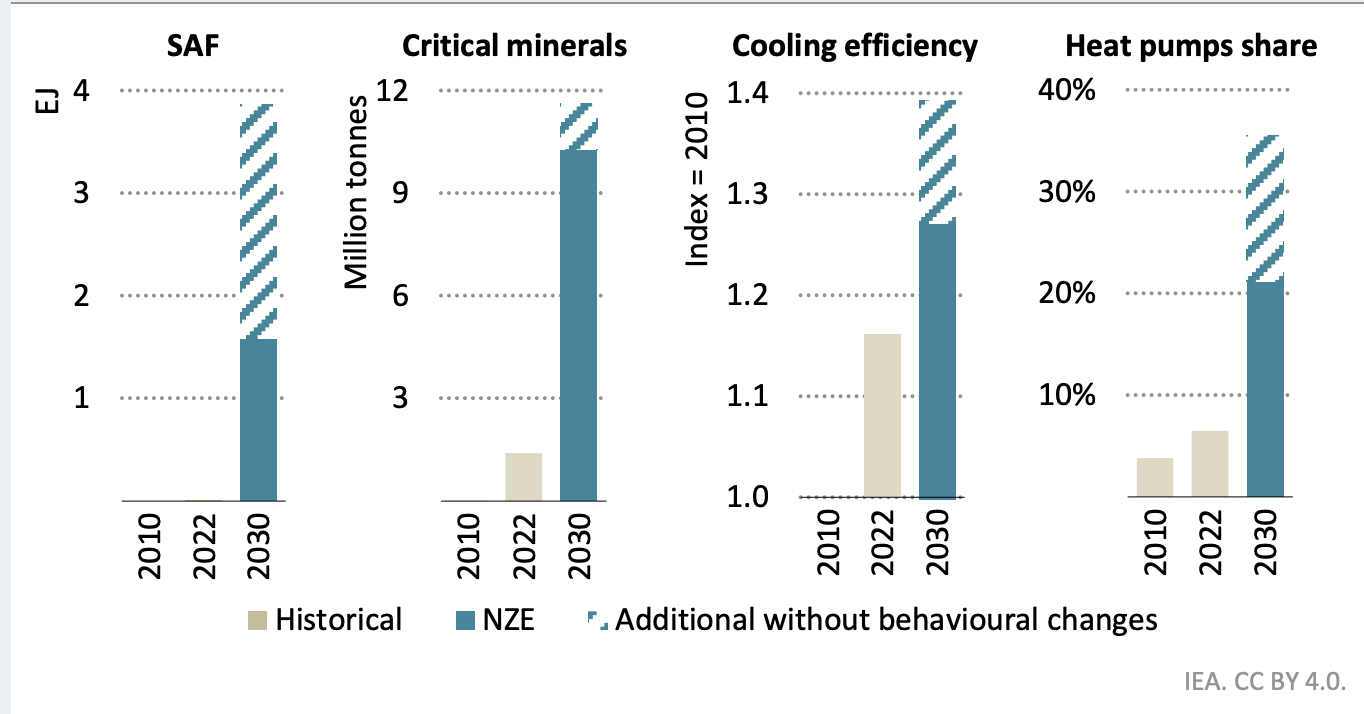
Figure 1 – Impact of behavioural change on technology deployment as assessed by the International Energy Agency in its NZE scenario. See here, Figure 2.6. SAFs are the “sustainable aviation fuels” I discuss below.
Among the sectors that are hard to decarbonise are aviation and agriculture in particular. As far as agriculture is concerned, the difficulty lies in assessing our capacity to reduce, through changes in farming practices, the nitrous oxide and methane emissions associated with crops and livestock. Reducing the meat share of our diet is today an important solution among those proposed that have a significant impact and that are often a key ingredient for reaching carbon neutrality.
As for aviation, technological solutions are conceivable in the medium term to produce synthetic fuel from electricity and carbon taken from the atmosphere. But these solutions differ fundamentally from those envisaged for decarbonising steel or for electric vehicles: they involve large additional energy and economic costs. Let us first recall that the electric motor has a major advantage over the internal combustion engine, because it requires almost three times less energy. About 25 kWh of electricity are needed to travel 100 km, against something like 60 kWh of oil. The same phenomenon exists with heat pumps compared with gas or oil boilers. This is one of the reasons why the comparison made between primary energy and final energy is inconsistent today [Zenon 2023] (see [Note 1] at the end of the page). Unfortunately, in aviation an electric motor is conceivable only in a very small minority of cases. Storing energy in batteries will always be too heavy except for short journeys, and storing hydrogen will always take too much space unless it can be stored at high pressure in an aircraft, which is far from settled (see [Note 2] at the end of the page). Beyond improving engine efficiency, the important solution conceivable in the medium term is what are called SAFs (“sustainable aviation fuels”) [Zenon 2024 — SAF explainer]. These consist in producing fuel from biogenic CO2. There are many solutions, but they all combine, in different ways, the use of biomass and the use of low-carbon electricity coupled with CO2 capture from the atmosphere. In the first case the volumes are very constrained if we want to avoid any competition with food or any risk of deforestation. For the second option, the energy efficiency of the processes is a problem: to obtain 1 kWh of synthetic fuel, almost 3 kWh of low-carbon electricity will be needed — the exact opposite of the efficiency gained by electrifying the internal combustion vehicle. While the energy volumes devoted to road transport will be considerably reduced, those needed for aviation will explode. Put differently, flying will mechanically become much more expensive and less used, or will keep running on fossil oil. Let us be clear: these solutions must be deployed in the long term, but if we want to obtain the energy volumes we consume today, or to supply a consumption twice as large by 2050 as some scenarios envisage, then we would need volumes of electricity and biomass that we can hardly hope for and that may seem disproportionate relative to what aviation represents in terms of use. That is why sufficiency in aviation has a much larger benefit than elsewhere — which is what the IEA results gathered in Figure 1 above reflect.
Beyond the example of agriculture, which would require a book of its own, the example of aviation is interesting and important. It is often taken as a symbol of excess, in the inequalities it reflects and through the size of its impacts. One must be fully aware of what a reduction in international flights (which are the source of most of the fuel consumed) would mean. Indeed, while international civil aviation accounts for 2.5% of global emissions (though contrails could contribute to doubling that impact), it is the source of about 4.5% of world GDP, very largely through tourism. A large reduction in international flights would mean a change in tourism activity, with no doubt a significant impact on the trade balance of a country such as France (almost €60 billion contributed to the French trade balance in 2022 by international tourism).
Making and keeping promises
Faced with our uncertain future and the anxiety it generates, we need a project that unites. The scale of the problem we face demands both ambition and realism. To borrow Hannah Arendt’s words, we must find “the faculty of making and keeping promises”. In her book “The Human Condition”, the importance of the promise in the face of the uncertainty of the future is mirrored by that of forgiveness in the face of the irreversibility of our past mistakes (see here). What we are living through is far from the violence the philosopher knew in her time, but one can feel a form of anger or incomprehension towards our elders who, for the most part, did not take sufficient account of the environmental implications of our way of living and producing. Above all, that feeling will grow as the environmental consequences become greater. This anger must not blur our analysis of the solutions to the crisis, nor lock us into the idea of “a single act from which we could never recover” and that would lead us to renounce using technology in favour of a form of sterile despair.
The historian’s work is precious: it teaches us to better understand our past mistakes. But one mistake of our elders was not to have made the carbon neutrality project as we are doing today. Accusing a few researchers of having imagined technological revolutions does not really help, and making technology a scapegoat is no more useful than believing it will save us. The neutrality objective took time to germinate — too long, accusing minds will say — and perhaps it is no longer possible to reach it by 2050, but it is a unifying promise. That is where Hannah Arendt’s message matters: we must look ahead and keep refining that promise, because the carbon neutrality project can still be improved: it is not supported enough, it should better include all populations, it should better allow us to take other environmental constraints into account, and so on.
The indispensable scenario work done by the IPCC in Working Group III is teeming with detail and quantified analysis. What Jean-Baptiste Fressoz reproaches Working Group III with is the coldness of the models and their quantifications, as well as the underpinnings this coldness conceals. It is true that these models still integrate societal levers too little, but these levers do have a new and important place in the supplementary materials of Chapter 5 of the IPCC’s sixth report (see there). In parallel, on a more modest scale, other scenarios such as ADEME’s (S1 was the most frugal of them) or RTE’s “energy futures” study integrate the impact of sufficiency but also show the implications associated with these choices and the importance of the role played by technology. One may regret that IPCC Working Group III is the object of such a systematic attack by Jean-Baptiste Fressoz (cited some thirty times, always negatively). For it is precisely a quantitative putting into perspective of all the impacts and all the levers that Working Group III’s work makes possible, and that is missing from the historian’s analysis of the role of technology.
Another important criticism made of IPCC Working Group III concerns its relations with politics and industry. I share the anger at seeing these relations sometimes lead us in the wrong direction, and I recognise that one must be able to denounce what deserves it. Yet it seems obvious to me that industry and politics must be stakeholders in these reflections. Indeed, our capacity to change ourselves as well as possible requires a rational assessment of all the problems we must face as well as of the solutions we want to bring to them. That is what Working Group III does. But that is not enough: action must be organised as well as possible within a societal project that integrates technology and its impacts, but also human societies, and above all our capacity to coordinate and to produce this transition. Machines, our elders, politicians — all designated culprits for the difficulties we are going through — stop us from acknowledging the major difficulty there is in having 10 billion human beings jointly build a project as ambitious as carbon neutrality and hold themselves to it. The risk will always exist, in a moment of weakness, of succumbing to hollow and harmful ideologies. Whether or not we manage to face all these challenges, giving ourselves a direction and working as well as we can without betraying our humanity and our planet should be the occasion to write a fine page of our history.
Notes
[1] Note on this subject that Jean-Baptiste Fressoz rightly criticises the analytical bias implied by percentage representations, yet allows himself to compare fossil primary energy with electrical final energy (in the graphs at the end of Chapter 7). That is exactly the type of representation we criticised in [Zenon 2023].
[2] Unless hydrogen can be stored at high pressure in an aircraft, which is far from settled. In addition, mitigating the warming effect of contrails remains a rather problematic question see for example here.