
Summary – Do we have too much oil and gas, or should we fear that our reserves will not be sufficient? What I explain here is that we have far too much coal, gas and oil, and that discourses pushing fear about declining reserves are backward-looking. In the case of oil they remain fairly common. They are a way — consciously or not — of shifting anxiety outside the field of the climate problem and of the credible solutions we can bring to it. They indirectly help justify maintaining the status quo on oil, and sometimes even justify new exploration. In a second part I explain that the real difficulty in the transition is not developing alternatives to oil but rather global coordination, to avoid using everything we have, and the slight competitiveness differentials that can exist on certain end uses in the absence of coordination. In Europe there is a great deal to be done that is in our interest, coordination or not, in order to accelerate the exit from oil. A simple first step in France in the short term, in addition to deploying electric vehicles, would be to put a floor price on fuel at the pump through a floating fuel tax (TIPP).
Too much fossil fuel
A few days ago, a student who had been told at length about peak oil seemed surprised that I could say the problem was precisely that we had too many fossil resources: too much gas, too much oil and too much coal. This is a scientific fact known for a long time, widely documented and demonstrated, for example, in this article published in Nature in 2015. The subject is no doubt more widely covered today through that of “carbon bombs”. If we want to keep the temperature rise below 2°C, we can only consume a fraction of the proven reserves of oil, gas and coal. The Nature article proposes a breakdown of this, and the Guardian published a good infographic about it. In the 10 years since that article, it is clear that the picture can only have worsened: our carbon budget (what we can still emit between now and 2050 to stay below a 2°C rise) has been considerably reduced since 2015. Over the same period, the proven reserves of oil and gas have increased.
Fossil reserves and how they evolve.
The concept of a reserve is subtle, and to better understand what it involves one can read these recent articles from Connaissance des énergies about oil, gas and coal. As far as coal is concerned, proven reserves have been declining for some time already, but in volume they are far larger than those of gas and oil combined. Going by the BP Statistical Review of 2021, one can say that despite our large consumption, proven oil and gas reserves have held steady or even increased slightly over the past 10 years. Proven natural gas reserves stand at around 190 Mm^3 while world consumption is about 3.5 Mm^3/year. For oil, proven reserves are also relatively constant, at around 1700 billion barrels, while world consumption is around 35 billion barrels per year (see Wikipedia). That amounts to a resource of about 1900 PWh for gas and 2700 PWh for oil.
There are major geographical disparities in reserves. War and Peace. These are well known and documented. For an up-to-date overview, one can watch the first 5 minutes of the excellent analysis by Le dessous des cartes. These disparities are a source of tension, but they have also pushed some to maintain peace. The United States, for instance, has long been a fairly large producer, but has always sought to maintain relations with the Gulf countries to secure supply for its own country and for its trading partners (Europeans, for example). That leads some to say that oil is a driver of peace. It is one of the central theses of Pierre Charbonnier’s latest book “Vers l’écologie de guerre: Une histoire environnementale de la paix”, which speaks of a “fossil peace”. Yet it is also clear that many countries have gone to war to seize resources (including the United States and Great Britain in the Middle East). Matthieu Auzanneau’s book “Or noir, la grande histoire du pétrole” is very thorough on this point. One can also watch this historical review here. Let us recall that oil generates considerable profits that end up concentrated in a few hands. That concentration of wealth is not always a factor of peace and democracy. I do not think one can say that the advent of oil was more a factor of peace than a factor of war. Likewise, I do not believe it was a particularly essential element in the advent of democracy (which dates from a time when we had no oil), even if the withdrawal we must undertake is an ordeal in more ways than one.
Disparities can make action difficult, but they can also accelerate it: countries that do not have much oil (like us) may want us to learn to do without it. Sometimes declining reserves can push major players into action, but it is also the alternatives that make progress possible. For example, China is by far one of the leading coal producers but has limited coal reserves compared with countries such as Australia or the US. It now has by far the most ambitious renewables and nuclear deployment programme in the world, and it is progressing, even if coal still holds too large a place. At the same time, despite their immense resources, Australia and the US have already made better headway out of coal than China. The US uses oil and gas; Australia still has a way to go and appears to be choosing renewables. On the coal phase-out one can read this article.
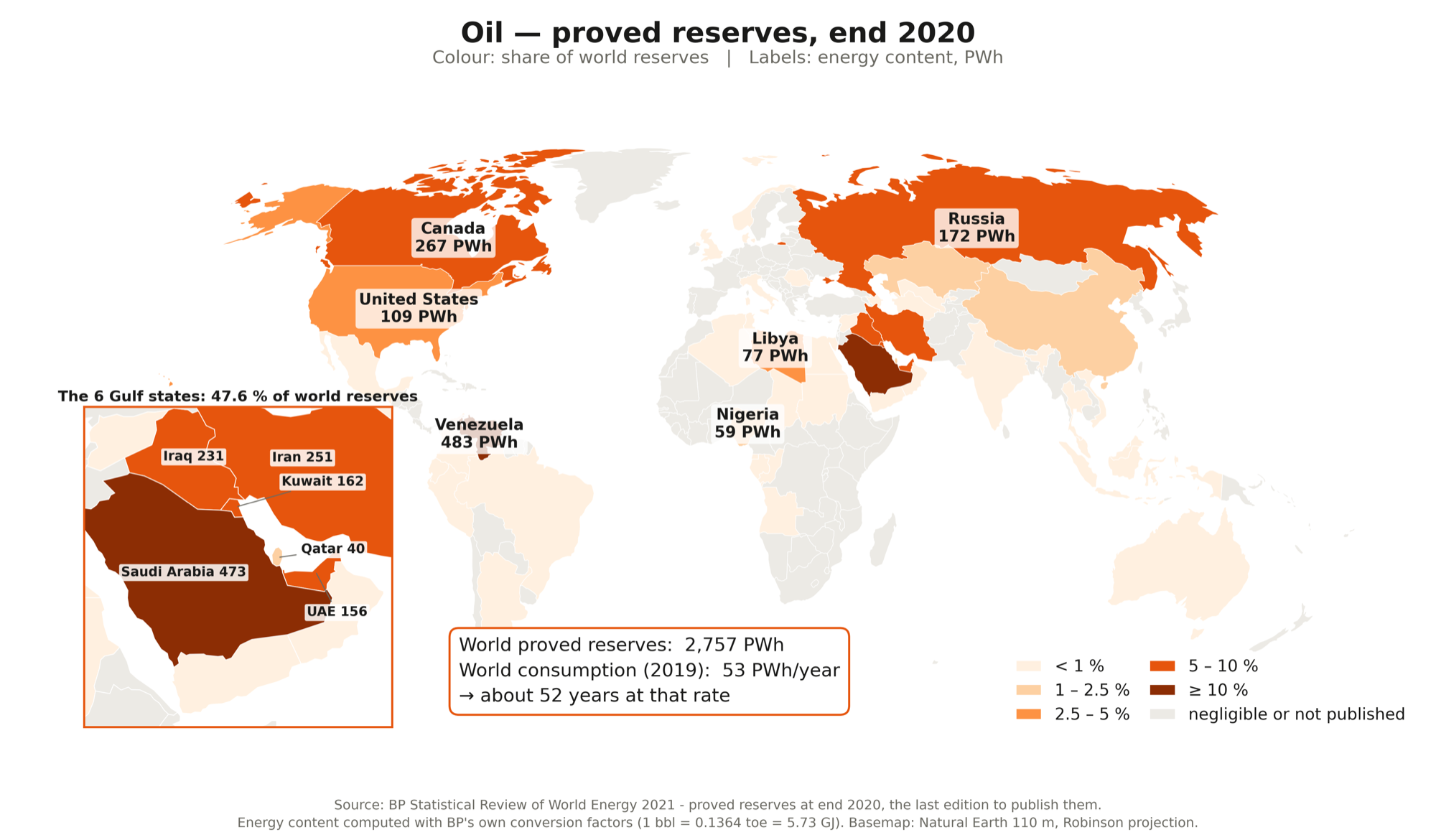
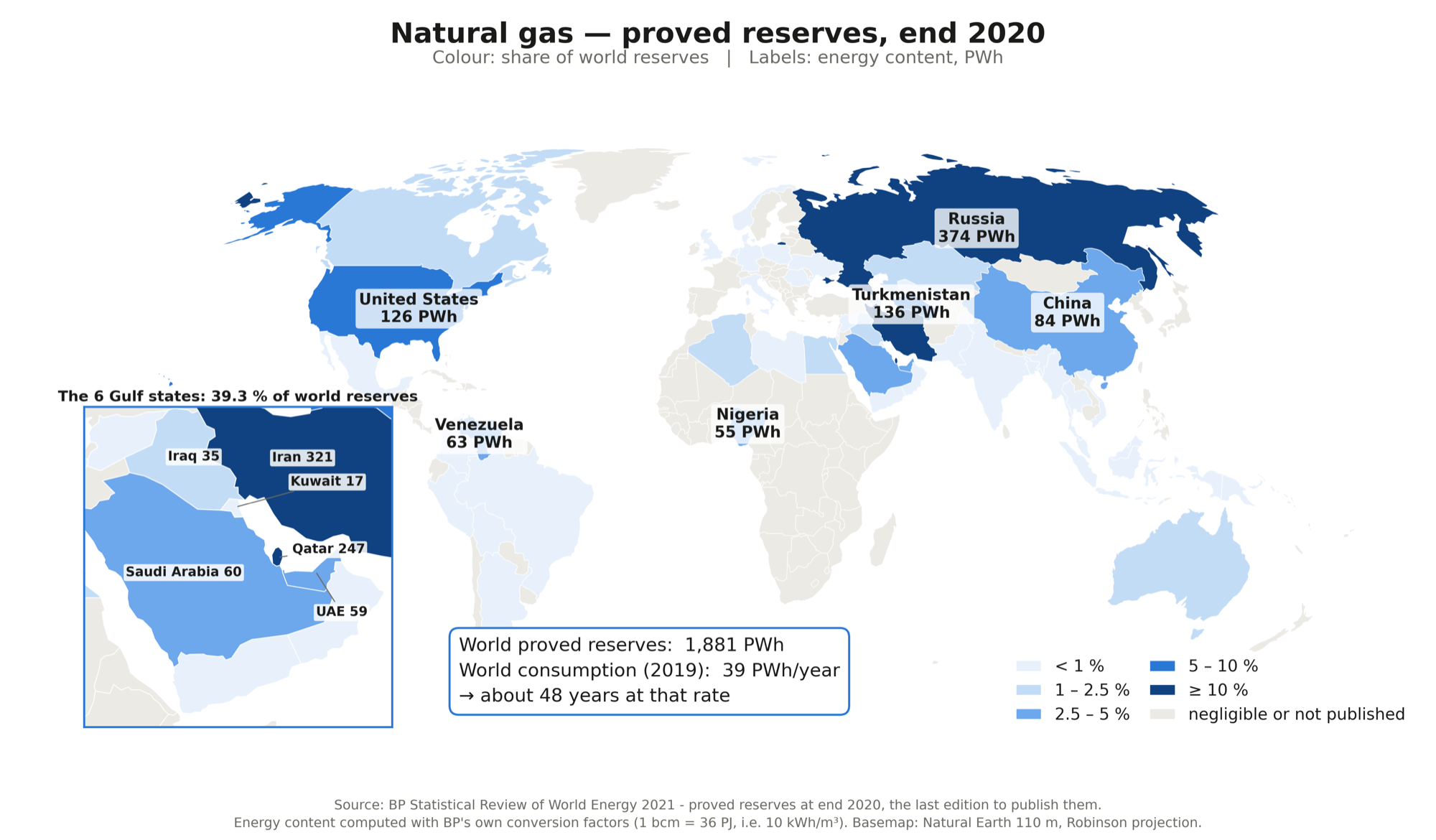
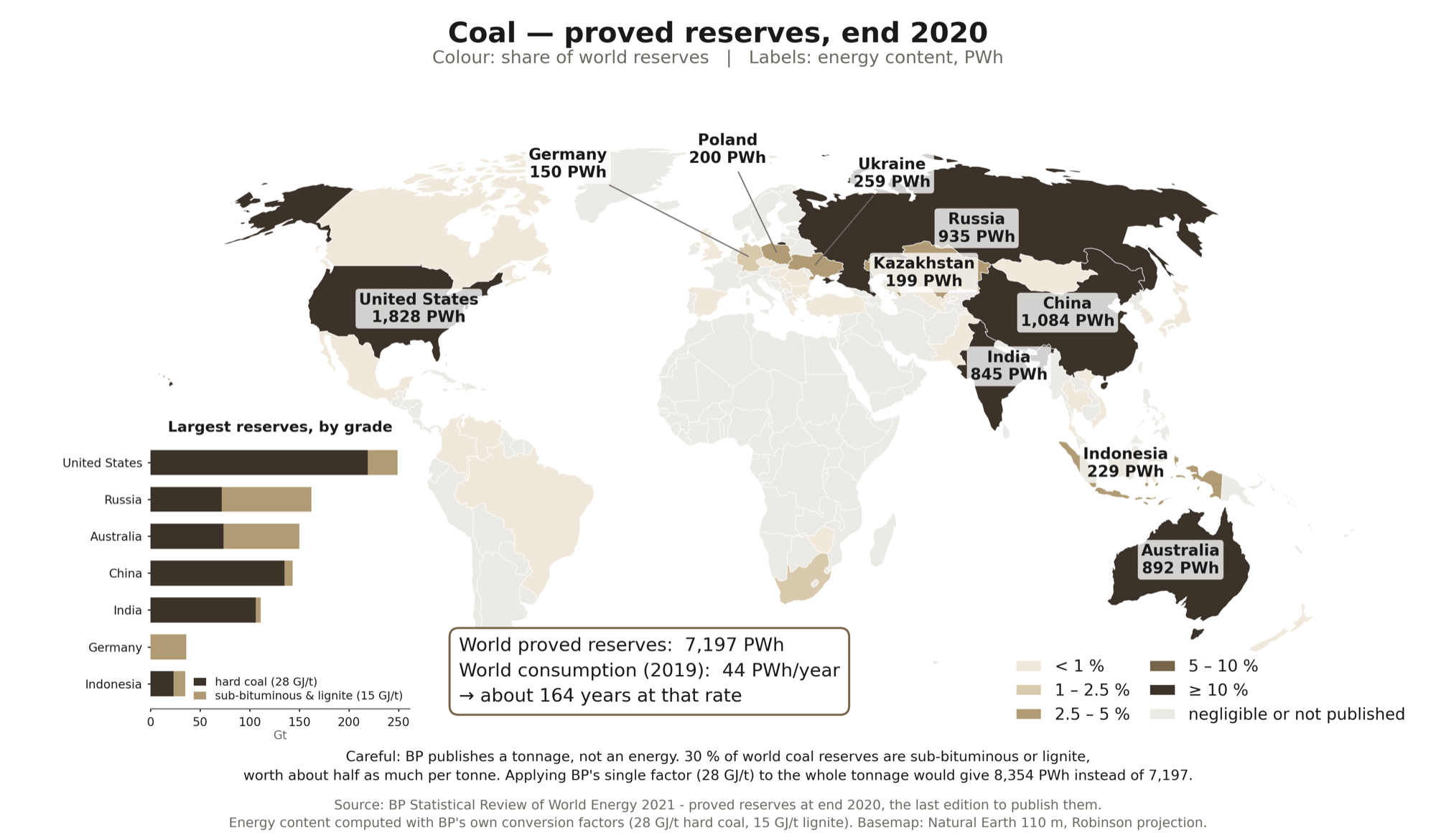
Figure 1 – Proved reserves of oil, gas and coal around the world, end 2020: colour gives each country’s share, labels its energy content in PWh. Source: BP Statistical Review of World Energy 2021, the last edition to publish reserves. On this subject and its geopolitical implications, see the first 5 minutes of the Le dessous des cartes video already mentioned in the text.
A decline in oil and gas reserves is coming. Proven reserves evolve with the money that can be put into them, but for years now the largest discoveries have been behind us (perhaps with the exception of Arctic fields, also linked to melting ice). The fall in reserves due to our consumption is still offset by new discoveries made possible by investment that remains substantial, but one can fairly say that we are already on a downward slope and that, in addition to being ever more expensive, new discoveries make us take ever greater risks, both economically and environmentally (deep-water offshore fields, recovery in existing wells by CO2 injection, shale gas and oil, polar fields, and so on). This decline in returns and this increase in risk have long been discussed in the literature, and are for instance what the historian Joseph Tainter writes about in his book “Drilling Down: The Gulf Oil Debacle”, following the Deepwater Horizon disaster of 2010 in the Gulf of Mexico.
But it is more of a plateau than a peak — bad news for the climate. For all that, from a climate standpoint one can say that the problem posed by the over-abundance of fossil reserves is greater today than it was 10 years ago. We are slowly reaching a maximum on oil and gas, but it looks more like a “plateau” than a “peak”. It is all a matter of scale, you will say. My point is absolutely not to date anything, nor to say whether it is a peak or a plateau, but above all to recall how much world oil and gas reserves should worry us through their over-abundance far more than through their decline, if we really want to limit the impact of climate disruption.
We indisputably have far too much oil, gas and coal. For oil as for gas, the remaining reserves are larger than what we have consumed since the 1970s. The conclusion of the Nature article is therefore already contained in the figure below, which shows past CO2 emissions by origin and then their desirable future evolution. The CO2 we have emitted since the 1970s through our use of gas and oil already far exceeds what we can emit in a 2°C scenario. Indeed, between 1970 and the end of 2024, cumulative CO2 emissions amount to 250 Gt CO2 for gas and 540 Gt CO2 for oil. Against that, our carbon budget — what we can emit between the start of 2025 and 2050 — is around 800 Gt if we aim for +2°C of warming and 300 Gt for +1.5°C (values obtained by extending those of the 2023 IPCC summary for policymakers, which gives the carbon budget in 2019). All this is without counting the two behemoths that dominate the equation: coal (550 Gt CO2 emitted since 1970 and still today the main emission source) and the emissions of greenhouse gases other than CO2 (methane, nitrous oxide, etc.), which are not even shown here.
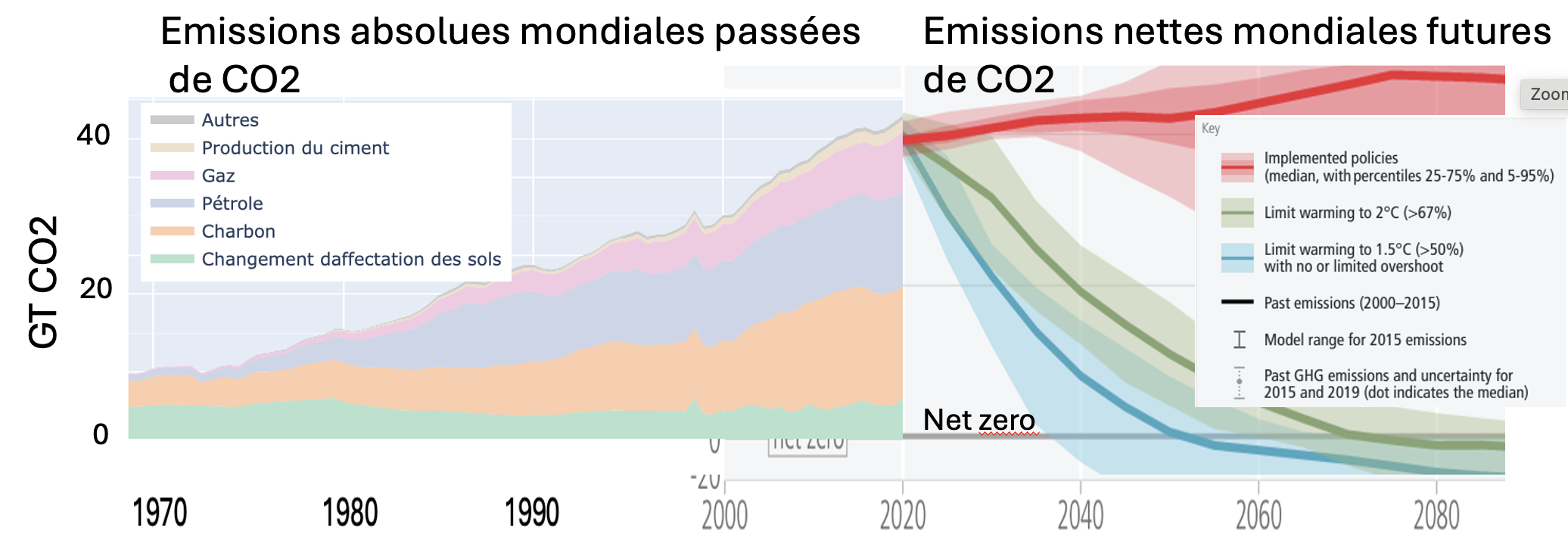
Figure 2 – Evolution of CO2 emissions in scenarios compatible with limiting the temperature rise to 2°C. After the 2023 IPCC summary for policymakers.
Climate action requires us to bring about peak oil and peak gas
We must bring about peak oil and peak gas. Without going so far as to say that peak oil will not happen, everything must be done so that it is caused by our global climate policies and definitely not by our oil and gas consumption. We must urgently bring about a decline in our consumption of oil, gas and coal. There are two difficulties here: on one side, technological alternatives must be developed at the same time as sufficiency in end uses; on the other, we must stop ourselves from using what lies beneath our feet. On both counts, global disparities are very large and make the problem even harder. Some countries that have no oil will be more inclined to reduce their consumption, but those that do have it will want to keep using their treasure — and that treasure will be all the more valuable if alternatives are slow to develop, at home and elsewhere. On the question of the oil that lies beneath our feet in various countries around the world, we may have to accept that “cheap” oil will be consumed, but everything must be done to avoid launching new extraction, especially the most expensive kind. Note that when the oil price falls low enough, some producers are liable to cut their output, either to avoid selling at a loss or in the hope of selling at a higher price later; that is what happened after the 2008 crisis. It will happen if demand falls today and if we develop the alternatives. So everything must be done to develop our alternatives, push sufficiency, and frame all of it with a suitable tax policy. But let us first briefly discuss the development of alternatives.
The big item for reducing demand in the short term is heating oil and above all motor fuel. What are we talking about here in terms of alternatives? First and foremost, the direct electrification of transport and heat. To begin with, we need to understand what our end uses are: in France and in the world they are shown in Figure 3. The big item is indeed oil consumption in cars and trucks. And for that we must deploy electric vehicles and the associated industry as fast as possible, without this conflicting with the necessary sufficiency (see our posts here and there). For industry, it is a matter of electrifying heat, and that too can move forward in the short term. For plastics (a good part of “non-energy use”), it is a complex sector, sometimes announced as one of the oil companies’ lifelines, but with a modest volume in consumption terms (about 15% in the world and in France). Above all, a great many things are possible in the very complex plastics sector, both in the short and the long term; we discuss them at length in this Zenon report on plastics. Today shipping is turning to gas and should move in the medium term to methanol and in the long term to ammonia (see our Zenon report on ammonia; another is coming on maritime transport more generally, where energy savings are also possible thanks to the use of sails). As for long-haul aviation (the bulk of the volumes), we must acknowledge that this is where the difficulty is greatest, and that sufficiency (flying less) is no doubt the first lever, even if other levers cannot be forgotten (see the Zenon report on SAFs). On the question of sufficiency we also refer to our last post here.
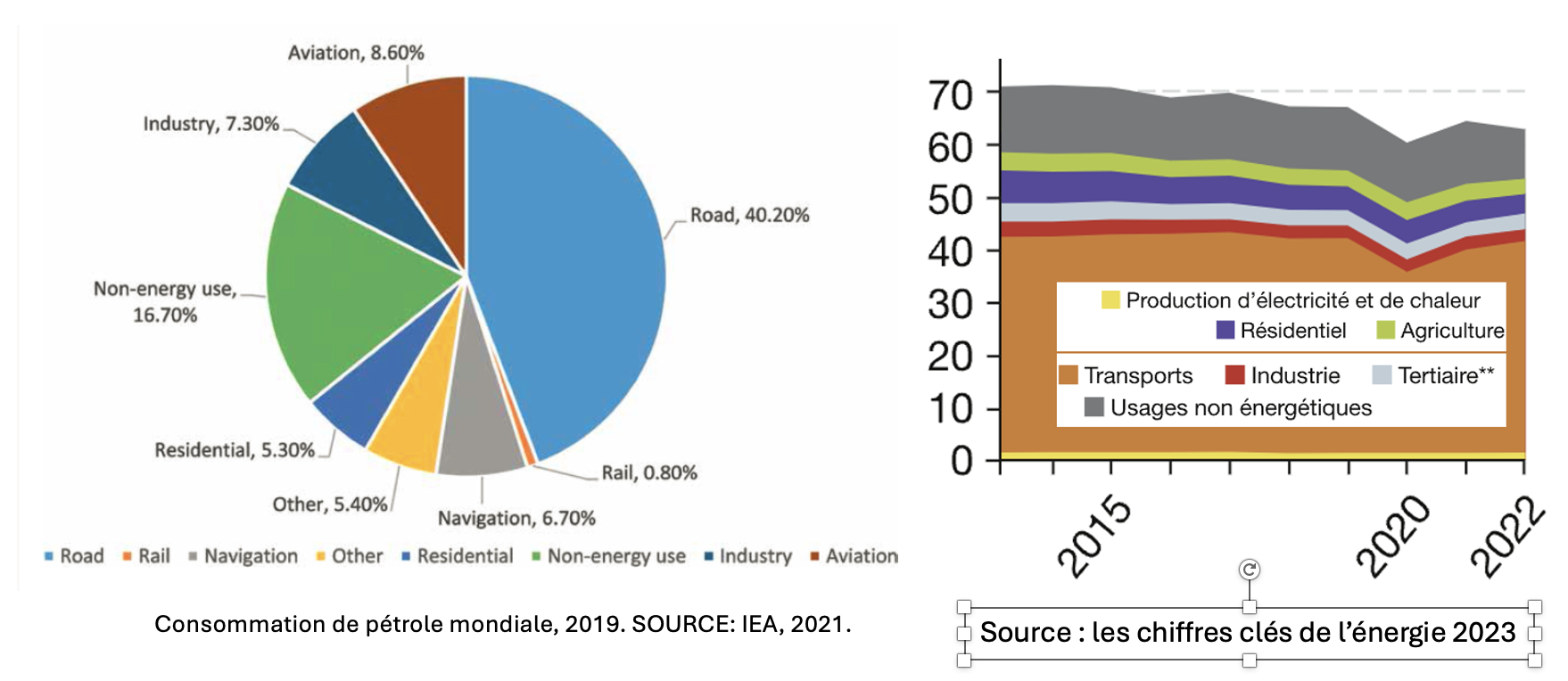
Figure 3 – Breakdown of the end uses of our oil consumption, in the world (left) and in France (right).
The difficulty is not developing alternatives to oil. The difficulty is global coordination
I do not think that developing the alternatives is a major difficulty. The technologies are mostly known. We know how to deploy them in Europe and in many countries around the world. Is it really necessary to repeat what is involved? On the supply side: low-carbon electricity (a lot of renewables but also some nuclear), and to a lesser extent biomass. On the demand side: direct electrification as far as possible (transport, heating, industry), a little indirect electrification (with hydrogen in industry and perhaps in transport), but also sufficiency and efficiency. The difficulty of developing alternatives is greater in regions of the world that lack the means or that have abundant fossil resources. Global coordination is difficulty number 1, by far: coordinating to support those who lack the means in developing the alternatives; coordinating to prevent those who have fossil resources from using them; coordinating to prevent unvirtuous producers at world level from crushing those who try to comply with environmental standards. This coordination happens through discussion, the COPs, financial compensation, political pressure, the search for an alignment of interests, and organisations at different spatial scales (city networks, countries, world regions, industry associations, associations of world citizens, and so on). Let us not underestimate this major difficulty. Coordinating 7 billion individuals whose resources are very unevenly distributed, in order to make progress in this necessary transition, is very hard. How far will we have to go to impose the transition? Pierre Charbonnier, in the book already mentioned, argues that we are afraid of war. Philippe Zaouati’s speculative novella “Discours sur l’état de l’union” is interesting on this subject.
“Local” action can foster global coordination. The choices we make for ourselves also bend global trends. For instance, Europe has a major role to play with respect to the current fall in oil prices (due to falling demand in China and in the US): are we going to revive demand, refill the oil companies’ coffers and give them a chance to invest again to relaunch world production? Or are we going to take advantage of this fall to set money aside in order to develop alternatives to oil and precipitate the over-abundance of black gold and the fall in prices? How can we ensure that this fall in prices does not lead to over-consumption elsewhere?
In France we need to push electricity; at the very least we must put a floor price on oil. There is a great deal of talk at the moment about the money we lack, and we know that part of the difficulty we face today was caused by the tariff shield, which made it possible to avoid too sharp a rise in the cost of energy (oil, electricity, gas) during the crisis. At the same time, the difficult budgetary equation we must solve in implementing the new law to restore the public finances is leading some to tax electricity a little more. And yet we know how much decarbonisation requires both long-term price visibility on electricity and electricity at a controlled price. That is why the government is asking EDF for “efforts” today.
But who is talking about putting a floor price on oil? Yet the method is simple: it would be enough to introduce a floating fuel tax (TIPP), as in the 1990s and 2000s, when we wanted to avoid price increases. Because we financed the tariff shield to avoid price rises, and now that the price of fuel at the pump is falling we pay less than €1.5/l of diesel where it was rather €1.8/l a year ago. The fall will continue, and the government is going to raise taxes on… electricity (on this subject see Christian de Perthuis’s excellent article).
As explained above, a major challenge is precisely to kill oil investment by preventing demand from rising again when prices fall. Yet demand is falling today (for reasons unrelated to the transition) and demand will fall later, with the transition. Putting a floor price on oil is a short-term opportunity and an indispensable long-term lever.
In France we retain an attachment to oil.
In France the question should not be so complex, since we have few resources and oil weighs on our trade balance (€50 billion in 2022, probably around €30 billion/year in previous years). But it should also be noted that we have a large company that draws substantial profits from oil — something between €15 and €20 billion a year since 2010 for TotalEnergies. That is a sum that must not contribute much to improving the trade balance, since Total claimed that it was not possible to tax the windfall profits made during the crisis because these were not largely made in France. In 2017 Patrick Pouyanné was “convinced that we were going to run out of oil”, and said more recently that “believing in a sudden end to fossil fuels is dangerous”. The French are not fooled — he is the boss of TotalEnergies — but the message carries more weight when it comes from an independent energy expert who defends the climate (see this 2023 video). Conversely, Didier Holleaux, a former vice-president of ENGIE, recalls in the introduction to his (excellent) book “La véritable histoire du gaz” that we have too much gas and oil.
Finally, the memory of the “gilets jaunes” also weighs on people’s minds and prevents French politicians and citizens from believing in the feasibility and the necessity of a rapid decline in our oil consumption. Fundamentally, what must be managed is the way a high oil price bears on the most deprived. On the one hand, this does not raise the price of oil the way it was raised at the time of the gilets jaunes, and on the other hand this type of measure must be accompanied by support such as the “energy voucher”. It is neither the working classes nor France that benefit from our current dependence on oil, but without supporting the most deprived it will be difficult to move forward. Fortunately, Europe pushes us towards ambition, as it often does on environmental questions, and the coming ban on the sale of new oil-powered vehicles gives real visibility that can slow investment in new oil wells, which could well quickly become stranded assets.
Peak-oil enthusiasts are very active in France. I think that analysing how the disparity of oil and gas resources evolves, as well as the underlying geopolitical questions, is important and must continue in France and worldwide. In that respect I follow with interest the publications of the French association for the study of peak oil, “ASPO”. That said, I find it odd that the question of peak oil is still so widely discussed among energy experts, and the dynamic carried by ASPO does have something very backward-looking about it. It contributes to worsening our problems: enthusiasts of the peak question, philanthropists in love with the Hubbert curve who have been trying for years to share their anxiety about remaining stocks. The list of its members is instructive: it is not made up only of a few worried people, and one also finds there sharp minds who no doubt judge it useful to perpetuate a form of anxiety about the peak. Their message is fairly simple, and I would say their work is effective, since you who are reading me may well think, deep down, that: (1) oil is running out and this is going to cause us problems, because (2) it is indispensable to maintaining our democratic society (are the gilets jaunes not proof of that?) and (3) there is no credible alternative (oil is so energy-dense, so convenient and so cheap!). I am not saying that the questions relating to these three claims are trivial, but unfortunately, while the outcome of such rhetoric escapes some, there are others who have understood it perfectly: any strongly marked regulation will be avoided (why regulate, for example with a floor price, if oil is running out on its own, if it is indispensable and if there are no alternatives?) and a few new operations can be justified (our country’s power is at stake, is it not?). I will come back to point (3) in a later post, but one can consult Cédric Philibert’s excellent book on the need to deploy electric cars quickly. They must indeed not be too large, and the use of public transport and cycling must be encouraged, but electrifying the vehicle fleet is a necessity and it can happen fairly fast. For today, I just hope we can agree that oil is not running out fast enough — and that the same is true of the backward-looking communication on this subject.