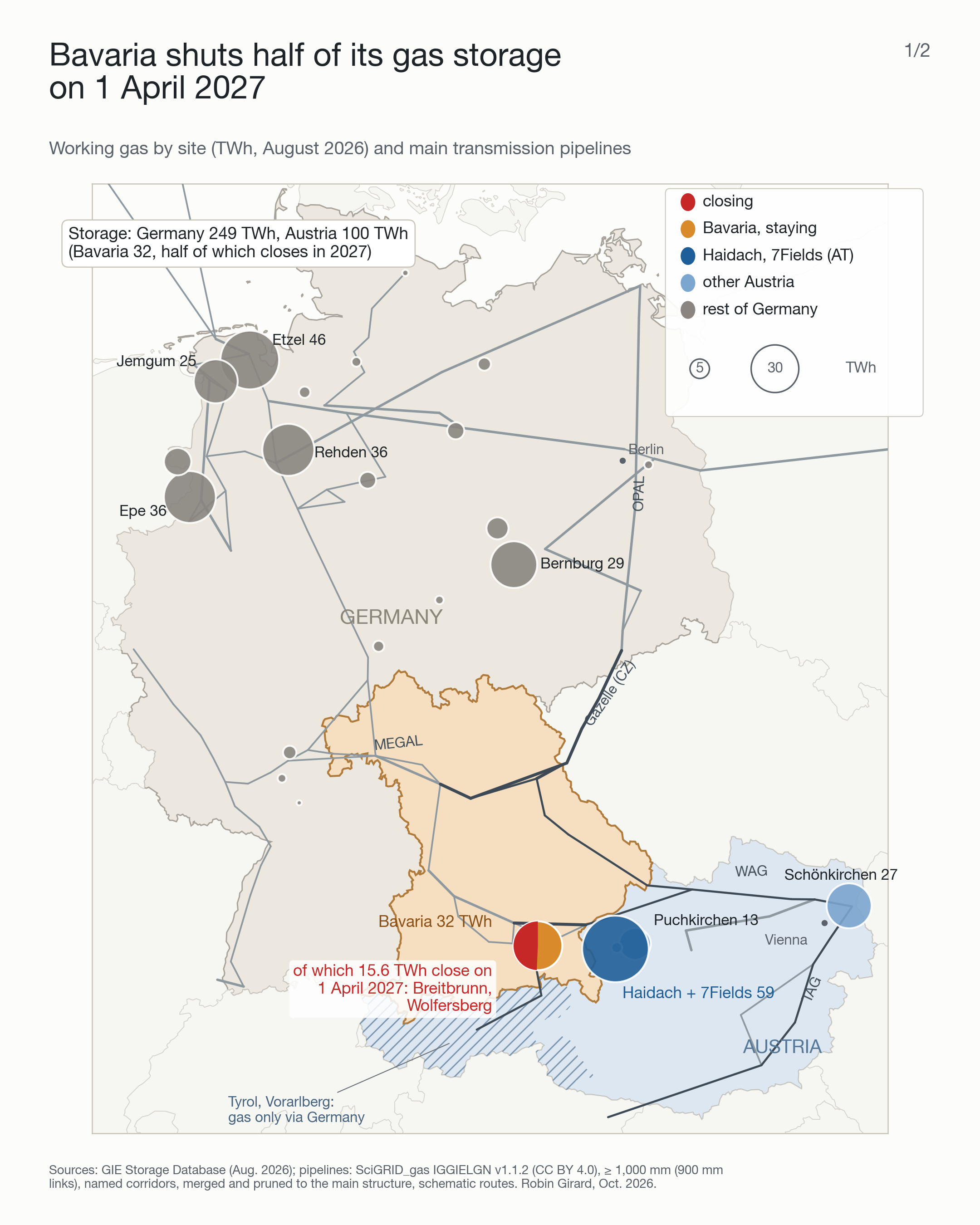
The post went out as a two-page carousel: the map above, then gas consumption in 2025 and 2030 (Germany excluding Bavaria 745 then 638 TWh, Bavaria 119 then 102, Austria 82 then 78; total 946 then 818, −14 %). Bavaria 2025 is an energy-balance estimate (IE Leipzig for the Bavarian ministry); for 2030, no Bavarian projection is published and the German rate is applied. The 2030 projections are those ‘with existing measures’: UBA for Germany, the Austrian Umweltbundesamt (WEM 2025) for Austria, which barely falls; with additional measures (WAM), Austria would be at 56 TWh. On the map, pipeline routes are schematic (straight SciGRID_gas segments, pruned to the main structure).
The text of the post
On 1 April 2027, Bavaria will lose half of its gas storage: 15.6 TWh, and this is no April Fool’s joke. It is stirring up some debate, and we had better get used to it, since the future of gas means closing a significant part of its infrastructure. Let us look at it in detail.
Uniper and bayernugs have applied to shut down two former gas fields in Bavaria, used as seasonal storage: Breitbrunn and Wolfersberg. For the coming winter, Uniper has sold only 5.3 of Breitbrunn’s 11.4 TWh. This is not a political decision: nobody pays to fill them any more, but the German state owns 99 % of Uniper, which is pushing for the closure, and Munich opposes it. The Bavarian economy ministry paid the engineering firm ILF for a study, presented in Vienna last week (I was there!). To find a problem, it stacks up the 1995-1996 winter, the coldest in its series, the absence of the Austrian storage sites and 25 GW of additional gas power plants.
The fear is not unfounded, though. Bavaria will not run short of stored gas; it may run short of withdrawal rate on a very cold day, and it will depend on Austrian storage with no contract to guarantee it. The two sites provide a third of Bavaria’s withdrawal capacity. The Haidach and 7Fields storage sites, in Austria, make up for the volume, but the German-Austrian agreement on their use in a crisis expired at the end of 2025. And Tyrol and Vorarlberg receive their gas only through Germany: each depends on the other’s infrastructure.
Does Uniper have an interest in closing? It holds about 27 % of the storage in the German market: less supply makes the rest more expensive. But it is within its rights, and the trends are on its side. The summer-winter price spread that kept storage alive (+0.5 to +5 €/MWh from 2014 to 2020) has been small or negative since 2022, and futures do not pay it before 2029. On top of that, global LNG supply should grow by more than 100 billion m³ by 2027, even if the Hormuz crisis delays it: a cargo bought in January competes with gas stored in July. Above all, Germany consumed 1,029 TWh of gas in 2021 and 864 in 2025, and official projections take off another 14 % by 2030.
Closing storage sites is the way history is going. The question is who pays for the insurance until then: Berlin proposes a 24 TWh state reserve, funded by a levy from October 2027.
Sources: Bundesnetzagentur, Bavarian Landtag, GIE (August 2026), ILF for the StMWi (May 2026), Uniper (2025 annual report), OIES, Frontier Economics for the BMWE, UBA.
Sources
- Bundesnetzagentur, rétrospective gaz 2025 (12/01/2026) : consommation allemande
- Landtag de Bavière, Drs. 19/12174 (29/06/2026) : Breitbrunn et Wolfersberg, capacités, réservations, dates d’arrêt
- GIE, Storage Database (août 2026) : gaz utile et soutirage par site
- ILF pour le StMWi, Plausibilitätsbetrachtung von deutschen Erdgasspeichern (mai 2026)
- Uniper, rapport annuel 2025 : actionnariat, dépréciations des stockages
- BNetzA et Bundeskartellamt, Monitoringbericht 2025 : marché allemand du stockage (289 TWh)
- Frontier Economics pour le BMWE, évaluation des obligations de remplissage (30/10/2025) : écart été-hiver 2014-2025
- OIES, The LNG Wave in 2026/2027 (février 2026)
- AIE, Gas Market Report T3-2026 : Ormuz, écart été-hiver 2026
- UBA, Projektionen 2025 : tableau des indicateurs (gaz fossile 2025 et 2030, scénario avec mesures)
- Accord germano-autrichien sur Haidach et 7Fields, BGBl. III Nr. 16/2023 (expiré le 31/12/2025)
- ÖNIP 2024 : le Tyrol et le Vorarlberg reliés au seul réseau allemand (§ 2.3)
- IE Leipzig pour le StMWi, Energiedaten.Bayern – Schätzbilanz (24/08/2026) : gaz en Bavière, 2025
- Umweltbundesamt (Autriche), Energie- und Treibhausgasszenarien 2025, REP-0995 : gaz 2030, WEM et WAM
- Réserve de gaz de 24 TWh : avant-projet du BMWE (presse, 13/10/2026)
- SciGRID_gas IGGIELGN v1.1.2 (CC BY 4.0) : réseau de gazoducs de la carte
Data
donnees_stockages_gaz_gie_2026-08.csv— Working gas by storage site (TWh, gross calorific value), GIE August 2026, grouped by geographic site, with coordinates and map category. A SEFE pool of 8.9 TWh, not located, is not on the map but counts in the German total.donnees_conso_gaz_2025_2030.csv— Gas consumption 2025 and 2030 (TWh, gross calorific value): Germany excluding Bavaria, Bavaria, Austria (WEM projection), Austria with additional measures (WAM). Conversions and assumptions in sources.md.
Code
To reproduce the figure:
python3 prepare_donnees.py         # GIE, SciGRID_gas, Eurostat -> tables et réseau élagué
python3 plot_carrousel.py          # le carrousel du post, deux pages, les deux langues
The map network is pruned on the graph: pipes of 1,000 mm and more, nodes within 20 km merged, 900 mm links only where they close a gap, spurs shorter than 120 km cut. Gazelle is redrawn through Bohemia, as SciGRID draws it as a straight line.
All files of this post (figures, data, scripts) are in the folder 2026-10-26-fermeture-stockages-gaz-baviere of the public repository.
Code under the MIT licence; texts and figures under CC BY 4.0; data remain under their producer’s licence.