The 36 weather years of ERAA 2025 are climate projections (PECD 4.2, three CMIP6 models), not observed winters. GW needs assume that each GW added cuts the national shortfall one-for-one, with no effect on neighbours; storage is simulated with and without recharge within a run of events. The simultaneity of Belgian and German shortfalls partly comes from curtailment sharing between countries, which is part of the ERAA method.
The text of the post
To get through winter, should you buy power plants able to run for 10 hours, or 2-hour batteries? Germany and Belgium seem to have given opposite answers.
On 3 November, Germany awarded 5.16 GW at €155,296/MW/year, for 15 years. The law requires holding 80% of output for 10 hours: every winner is a gas plant. In late October, Belgium contracted 2.4 GW at €18,000-22,000/MW/year, about 1 GW of it batteries.
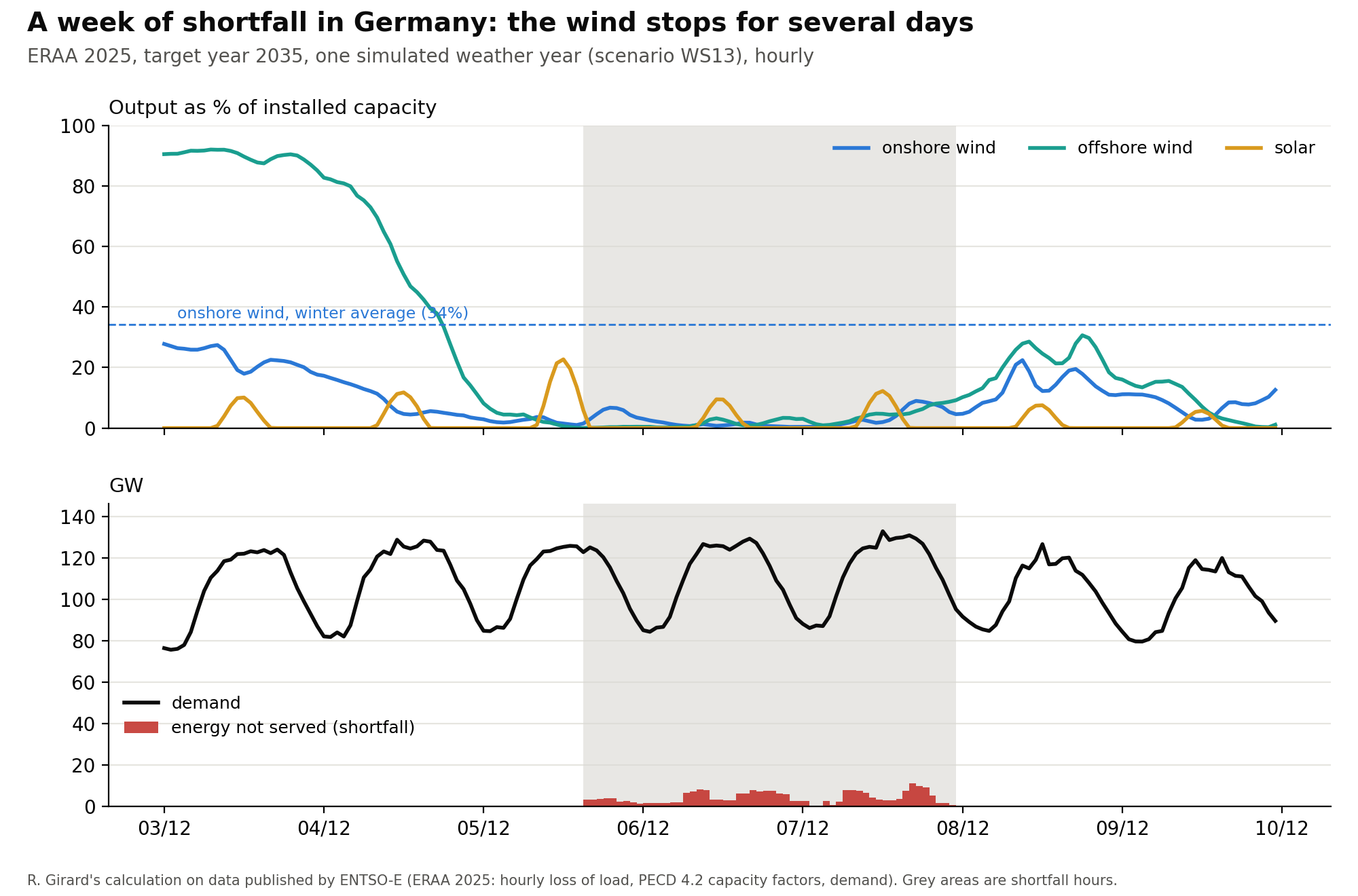
What creates the need? In Germany, windless winter weeks. Wind stops for several days in a row, heating demand is high, and the sun sets around 4 pm. The shortfall opens in the late afternoon, lasts all evening, comes back in the early morning and starts again the next day, in neighbouring countries too.
The data of ERAA 2025, the European adequacy assessment, show it. During shortfall hours, German onshore wind runs at 4% of capacity, against 35% on average in winter, and it had delivered only 10% on average over the three previous days. By 2035, the night itself no longer gets through: evening and morning merge, and three quarters of shortfall hours fall in events longer than 10 hours.
A 2-hour battery shaves one evening; it cannot carry three windless days. How much must be added to meet the standard? On ERAA data, about 9 GW of firm capacity in 2030 and 12 GW in 2035: the order of magnitude of the German auctions, 9 GW in 2026 and 2 GW in 2027. With storage, what is missing is energy: 140 to 340 GWh in 2035, 2.5 to 6 times what the 28 GW of batteries already assumed can store.
The same week, Belgium gets the same wind, but falls short by 1.6 GW at most: it receives a thin slice of a regional shortfall, 99% simultaneous with the German one. Long runs exist there too, and it answered like Germany, earlier: in 2021, its capacity mechanism selected 1.6 GW of new gas plants, for 15 years. October’s batteries complement this base, for 0.8 to 1.6 GW.
The United Kingdom counts a 2-hour battery as 22% of a firm MW: duration has a price. Germany’s 10 hours set it crudely, but they target the right problem.
First post of a series on how each country pays for its flexibility.
Sources: Bundesnetzagentur, Elia, StromVKG § 12, ENTSO-E ERAA 2025 (hourly data), NESO, own calculation.
Sources
- ENTSO-E, ERAA 2025, édition amendée après la décision ACER 06/2026 — rapports, annexes 3 (résultats détaillés), 4 (épisodes) et 6 (commentaires des GRT), données horaires d’énergie non servie, facteurs de charge PECD et demande
- ACER, décision 06/2026 sur l’ERAA 2025 (valeur unique de LOLE, borne basse d’aversion au risque)
- Bundesnetzagentur, résultats de la première enchère de capacités de long terme (StromVKG), 3/11/2026
- Bundesnetzagentur, FAQ des enchères StromVKG (§ 12 Abs. 5 : 10 heures consécutives à 80 % de la puissance)
- Elia, résultats des enchères CRM du 29/10/2026 (2027-28, 2028-29, 2030-31)
- Elia, rapports d’enchères CRM (dont le rapport Y-4 2030-31, ventilation par technologie)
- CREG, reprise de l’enchère CRM Y-4 2025-26 (cycles combinés neufs de Les Awirs et Seraing, 15 ans)
- NESO, facteurs de dérating du Capacity Market britannique (stockage selon sa durée, T-4 2029/30)
Data
donnees_semaine_eraa.csv— Germany, week of 3-9 December of target year 2035, weather year WS13, draw 6: onshore wind, offshore wind and solar capacity factors, demand (GW), energy not served (GW), hourly (ERAA 2025).donnees_semaine_eraa_be.csv— Belgium, same week and same draw: same columns.donnees_episodes_DE_2030.csv— Germany 2030: each loss-of-load event (consecutive hours with energy not served) across the 540 ERAA 2025 draws — duration (h), peak shortfall (MW), energy not served (MWh).donnees_episodes_DE_2035.csv— Germany 2035: same.donnees_episodes_BE_2030.csv— Belgium 2030: same.donnees_episodes_BE_2035.csv— Belgium 2035: same.
Code
To reproduce the figure:
# Données ENTSO-E (ERAA 2025) : ERAA_2025_HourlyENSData.zip, ERAA_2025_PECDRES.zip, ERAA_2025_DemandData.zip
python3 build_figure_semaine.py DE                       # semaine allemande (cas médian choisi par le script)
python3 build_figure_semaine.py BE 13 6 2035-12-05T15    # la même semaine vue de Belgique
python3 build_carrousel.py                               # épisodes Allemagne et Belgique, achats, carrousel PDF FR/EN
The scripts read ERAA 2025 hourly files downloaded from entsoe.eu; the analyses (events, weather, sizing) are counts and a bisection search, without a system model.
All files of this post (figures, data, scripts) are in the folder 2026-11-07-capacite-allemagne-belgique of the public repository.
Code under the MIT licence; texts and figures under CC BY 4.0; data remain under their producer’s licence.