The text of the post
Where can Europe still store electricity by pumping water uphill? The large sites are taken. What is left are the small ones: a lake and a natural depression, or two depressions, a few kilometres apart, with a few tens of metres of head.
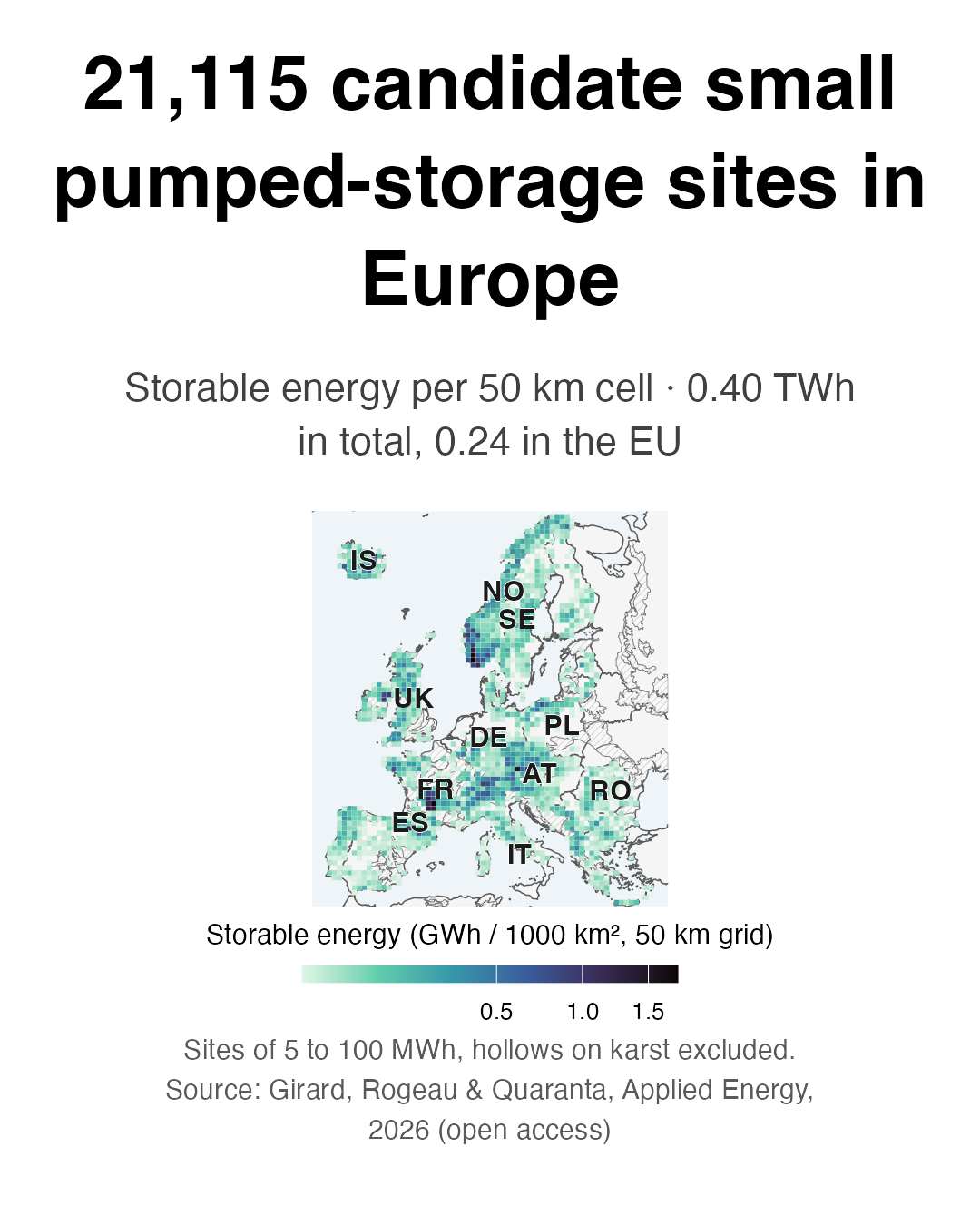
With Antoine Rogeau and Emanuele Quaranta (JRC), we have just published in Applied Energy, open access, the first European inventory of these small pumped-storage sites. Across 37 countries, our method retains 21,115 sites of 5 to 100 MWh, which together would store 0.40 TWh. In the European Union, 0.24 TWh: a little less than one hour of electricity consumption, but of the order of half the truly usable storage of all the EU’s large pumped-storage plants.
Three things I learned doing this work:
Karst. Our algorithm looks for closed depressions, and limestone plateaus are full of them. But a doline is closed because the water drains away through its floor. In 2017, our French study kept the depressions of the Grands Causses: they were dolines. Excluding reservoirs to be built on karst divides the resource by 2.5.
The elevation model. A surface model, which follows treetops and rooftops, invents depressions: in France, it gives five times the resource computed on the national IGN terrain model. And even a corrected model is not enough everywhere: in Norway and Sweden, switching to national lidar removes 72% of the energy.
Cost. About €1,150 per kWh of storage for the median site, by our indicative estimate: several times a large pumped-storage plant. And in our model, it is not the reservoir that costs, it is the pipes: kilometres of waterway for a few megawatts.
So this is a real resource, but an expensive one, often far from consumers, and one that field studies can only shrink: a tool for knowing where to look, not a promise. The data and code are open.
I explain all this, karst included, in a blog post (link in the comments). Paper: Girard, Rogeau and Quaranta, Applied Energy, 2026.
The full article
Small pumped storage: 21,115 possible sites in Europe, and what karst changes
Sources
- R. Girard, A. Rogeau, E. Quaranta, « Distributed small-reservoir pumped-storage hydropower in Europe: a GIS screening under drawdown and karst constraints », Applied Energy 427 (2027) 129193 (accès libre)
- Données : couches de sites candidats par pays et résultats des scénarios (Zenodo)
- Code : pipeline R/Snakemake (licence MIT)
Code
To reproduce the figure:
# Script : Blog/atelier/micro-step/figures/cartes/figure_linkedin_carte_europe.R
# (dérivé de workflow/analysis/fig_grid_energy_map.R du dépôt MicroSTEP, commit 5030284)
MICROSTEP_BLOG_LANG=fr OUT_PNG=$PWD/figure_micro_step_carte_fr.png Rscript figure_linkedin_carte_europe.R   # ou en
The figure redraws Figure 4 of the article from the results archived on Zenodo; all figures of the article are detailed in the blog article itself.
All files of this post (figures, data, scripts) are in the folder 2026-11-02-micro-step of the public repository.
Code under the MIT licence; texts and figures under CC BY 4.0; data remain under their producer’s licence.