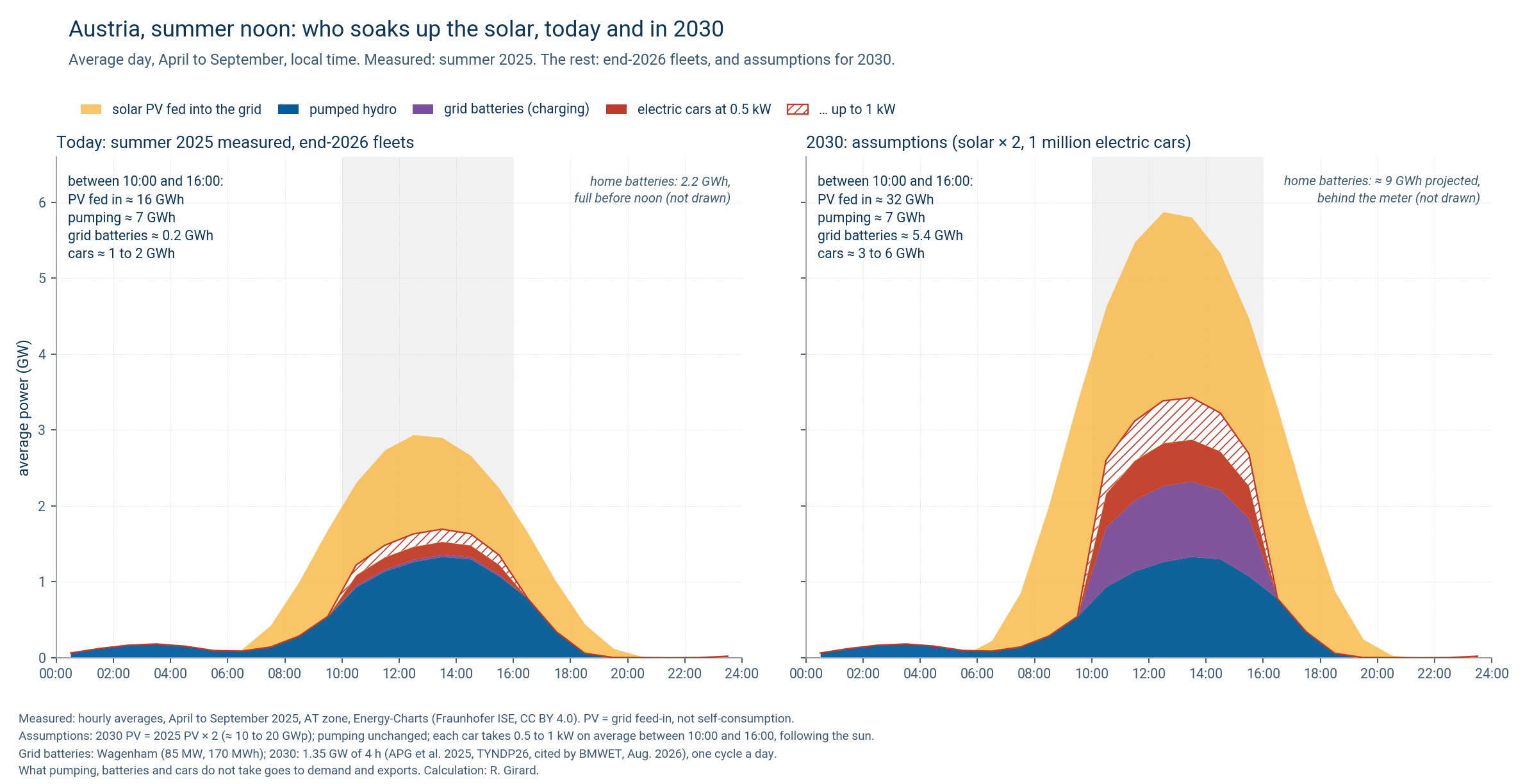
PV counts grid feed-in only, not self-consumption. The 2030 panel is not a simulation: it stacks stated assumptions on the measured 2025 day. The wholesale value of shifting charging to noon (€80 a year in 2025 for half of the charging) is computed with perfect foresight on Austrian day-ahead prices; only a customer on a dynamic tariff receives it.
The text of the post
Like many others in Europe, Austrians need flexibility. Following Germany, they bet on heavily subsidising self-consumption: between 2022 and 2025, the federal state committed €583m in support for solar PV and €206m for home batteries, not counting the Länder. The result: 2.2 GWh of batteries in people’s homes. But the energy ministry acknowledges it (August 2026): optimised for self-consumption, they are often full before the noon peak, which reaches the grid in full.
At noon in summer, Austrian solar feeds nearly 3 GW into the grid. From April to September 2025, the average wholesale price was €14/MWh at 1 pm, against €141/MWh at 8 pm, and 39% of the 1 pm and 2 pm hours had a negative price. Someone has to consume at noon. Pumped hydro already does, to the tune of about 7 GWh a day. And the market is now financing grid batteries, without subsidies: 85 MW and 170 MWh at Wagenham since September, 70 MW and 140 MWh at Theiß in 2027.
Meanwhile, the electric car is arriving: more than 300,000 battery cars at the end of September 2026. Since April, in summer, the energy part of the grid tariff is 20% lower between 10 am and 4 pm: about €16 a year in Vienna for a car that does half of its charging at noon, and only for the 13% of meters read every quarter hour. At wholesale prices, the same shift was worth about €80 in 2025, five times more. The signal arrives heavily dampened, and the resource is still small. That will change.
Suppose each car takes 0.5 to 1 kW on average between 10 am and 4 pm, i.e. half or all of its daily charging. Today’s 300,000 cars then make 150 to 300 MW, and 1 to 2 GWh a day: already more than the two large batteries combined. In 2030, with up to a million cars, it would be up to 1 GW. Grid batteries will have to share the value of noon with flexibility that is already paid for.
But solar will keep growing, from about 10 GWp at the end of 2025 to nearly 20 GWp in 2030: that GW of cars will cover only part of the need. We are entering the age of flexibility. Electric cars will be used massively within a few years, and suppliers who miss this turn will lose customers. The open question is whether the grid will keep up with these new loads.
Sources: E-Control (EAG report 2026, Smart Meter 2025), BMWET (storage, August 2026), AustriaTech, BGBl. II 305/2025, Energy-Charts (Fraunhofer ISE).
Sources
- BMWET (ministère autrichien de l’économie, de l’énergie et du tourisme), Analyse zur Weiterentwicklung der Stromspeicherlandschaft, août 2026 (batteries domestiques pleines avant midi, projections 2030)
- BMWET / Technikum Wien, PV-Speichersysteme – Marktentwicklung 2024 (2,2 GWh de batteries domestiques)
- E-Control, EAG-Monitoringbericht 2026 (aides au photovoltaïque et aux batteries, parc PV)
- E-Control, Smart-Meter-Monitoringbericht 2025 (compteurs relevés au quart d’heure)
- BGBl. II Nr. 305/2025, SNE-V 2018 – Novelle 2026 (SNAP : −20 % sur la part énergie du tarif de réseau, 10h-16h, avril-septembre)
- AustriaTech, Elektromobilität in Österreich, Zahlen und Fakten, septembre 2026 (318 556 voitures à batterie au 30/09/2026, d’après Statistik Austria)
- BMWET, Integrierter österreichischer Netzinfrastrukturplan (ÖNIP), 2024, p. 41 (environ 21 GW de PV en 2030)
- pv magazine, NGEN met en service 170 MWh de stockage à Wagenham, 14/09/2026
- EVN, communiqué sur la batterie de Theiß (70 MW, 140 MWh, 2027), 14/03/2026
- Energy-Charts (Fraunhofer ISE), prix day-ahead de la zone AT et production publique autrichienne, CC BY 4.0
Data
donnees_profil_midi_AT_2025_2026.csv— Austria, average April-September day in 2025 and 2026, hourly: day-ahead price, share of negative-price hours, grid-fed PV, load, pumping (Energy-Charts).donnees_valeur_flex_AT_2023-2026.csv— Arbitrage value at Austrian day-ahead prices, 2023-2026: 2-hour and 4-hour grid batteries, 8-hour storage, home battery in self-consumption and price-driven mode, electric car by charging time (€ a year).
Code
To reproduce the figure:
python3 sources/donnees/profil_midi_autriche.py <dossier_json>   # profil horaire depuis l'API Energy-Charts
python3 build_figure_2030.py                                       # figure, deux langues
python3 sources/donnees/valeur_flex_autriche.py                    # valeurs d'arbitrage 2023-2026
The 2030 panel stacks assumptions (solar × 2, battery and car fleets) on the measured 2025 day: it is not a system model.
All files of this post (figures, data, scripts) are in the folder 2026-11-12-flexibilite-autriche of the public repository.
Code under the MIT licence; texts and figures under CC BY 4.0; data remain under their producer’s licence.