
In 2018, minister François de Rugy, who had just succeeded Nicolas Hulot, announced that the target for the renewable share of our electricity generation was moving from 32% to 40%. Some see in this today a European takeover of French energy strategy [Leveque 29-09-2021], but it should be recalled that Europe did not invent these targets and that this was rather a matter of consistency with the objective of 50% nuclear in the electricity mix, which Nicolas Hulot had pushed back from 2025 to 2035 — and therefore a French initiative. Some still think that these figures bear no relation to any technical reality and that they constrain us, out of pure dogmatism, to develop renewables. The purpose of this short text is to recall a few orders of magnitude connected with these two percentages (32% and 40%), in order to set out the constraints they reflect, which are specific to how our system evolves. In this post we are going to explain two things:
- 1 - even if one advocates developing nuclear today, with new EPRs, or later SMRs, it is essential to develop renewables by 2030 in order to reach at least 32% in 2030.
- 2 - the level of deployment envisaged (32% or 40%) by 2030 depends rather on what we plan to do afterwards, out to 2060.
Several of the options open to us for 2060 are currently being studied by RTE [FutureEnergetique2050-Consultation] in its foresight work “Energy futures 2050”, to be published on 25 October 2021 (I will probably update this post marginally on that date, or write a new one) [XavierPiechaczyk2021-10-07]. We have already discussed it [France-Germany-Nuclear]. Among these options, we will recall two here:
- the "N1" option, which aims at a moderate deployment of new nuclear with only 8 pairs by 2060 (27 GW of nuclear in 2060, no doubt partly as SMRs).
- the "N3" option, which envisages a larger nuclear deployment to maintain 50% nuclear in electricity generation by 2060, with the construction of about 50 GW of nuclear. That capacity corresponds to 30 reactors like Flamanville, to be built by 2060, which means, on average between 2035 and 2060, more than 2 reactors commissioned per year. Note that the notion of a reactor is abstract here, since part of it would take the form of SMRs, smaller and more numerous. Moreover, the choice made in N03, championed by part of the nuclear industry, is to build only half of them by 2050 and to keep 24 GW of the historical fleet in operation at that date. The rest would therefore have to be built between 2050 and 2060, or later.
We will show that in the “N1” option it is quite natural to aim at 40% renewable electricity by 2030, whereas in the “N3” option it would probably be preferable to aim at 32% renewable electricity in 2030.
Detailed analysis of the changes out to 2030
The renewable share is today 21% of electricity generation (116 TWh/550 TWh). To analyse the situation in 2030, a simplified balance must be drawn up, incorporating what is unavoidable or desirable independently of renewables deployment: counting new non-renewable generation and the generation losses to come, as well as the increases in consumption.
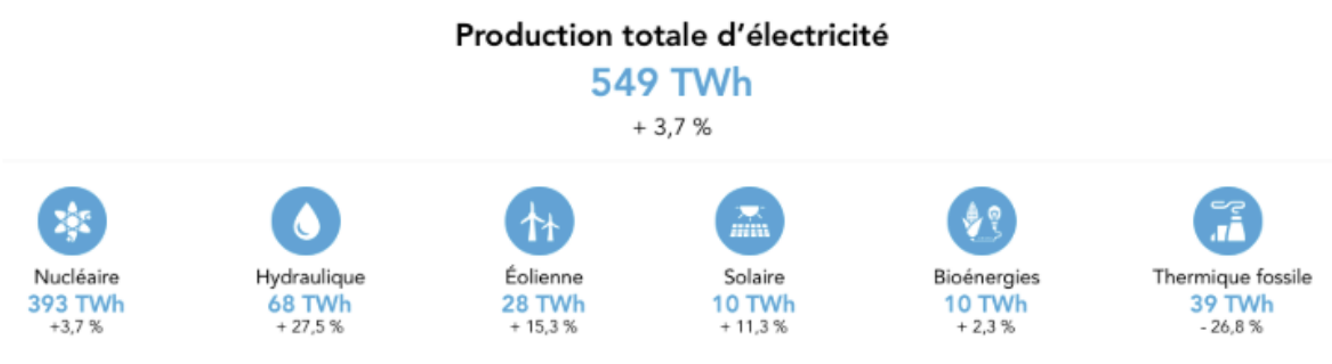
Figure 1 – Electricity generation in 2018 according to the electricity balance [RTE2019]. Consumption was 474 TWh and exports 75 TWh.
Electricity consumption must increase by 2030 to support the progressive decarbonisation of transport with electric vehicles and of heating with heat pumps, while maintaining our exports. RTE forecasts for 2030 (see p14 here [FutureEnergetique2050-Consultation]) an additional electricity consumption of about 50 TWh, despite energy efficiency and sufficiency measures that are also necessary, such as building renovation.
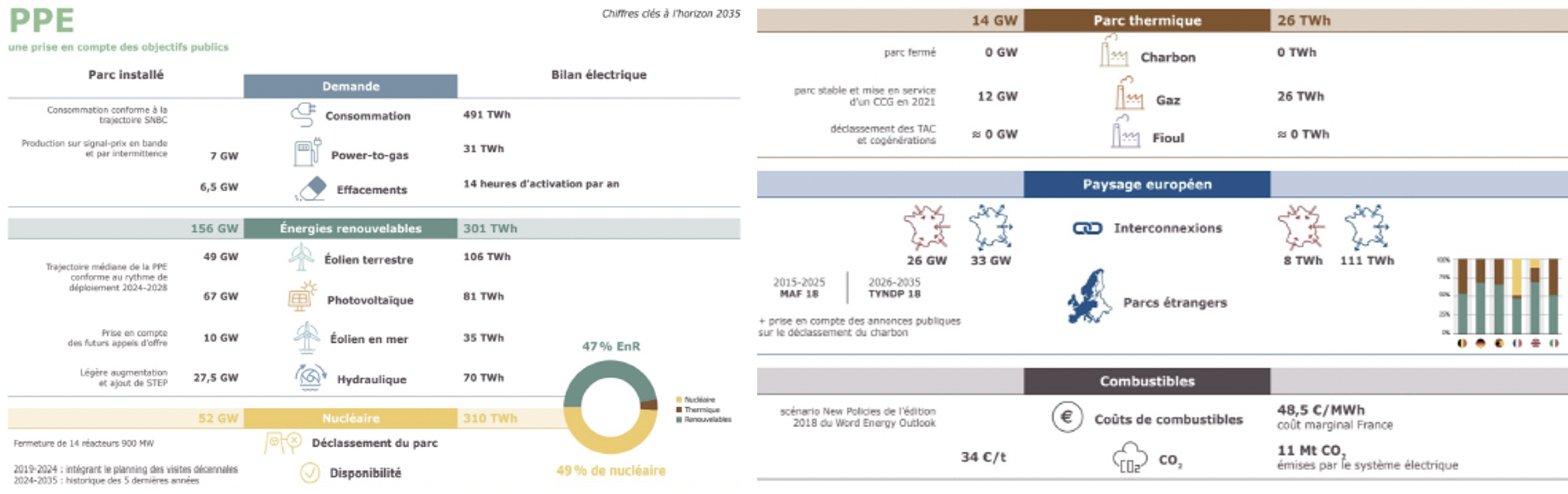
Figure 2 – Key figures of the 2019 network development plan (SDDR) for the PPE scenario [IntroductionSDDR2019] for 2035 (see p21). Note that the increase in electricity consumption forecast in 2019 by the PPE is much smaller than that expected in RTE’s ongoing analysis [FutureEnergetique2050-Consultation].
Let us now look at the coming changes in electricity generation other than renewables. Carbon-emitting thermal generation (gas/coal) must decline. For 2035, the PPE’s stated objective (see the figure above) is to go from 40 TWh to 25 TWh. One can imagine that in 2030 we would be at 30 TWh (so -10 TWh on thermal).
On the nuclear side, note first that even if the next government decides on a relaunch, with the construction of new EPRs — which is no doubt desirable — these new plants will not be commissioned before 2035 (apart from Flamanville 3). So on the nuclear side, one should rather try to quantify a fall in generation, which could be about 10 TWh because of the refurbishment programme, and 10 TWh through a lower load factor caused by renewables (I discuss these two figures in the appendix). Without any nuclear plant closure, that could therefore represent 20 TWh less.
We will consider two scenarios here regarding nuclear plant closures and the evolution of exports out to 2030.
- Scenario a - No nuclear plant closure by then, and a 20 TWh fall in our exports.
- Scenario b - Exports increase by 10 TWh, and 5 reactors of 900 MW are closed (-28 TWh, see appendix for the calculation)
The table below summarises this analysis. By construction, the figures of 32% and 40% appear in these two scenarios.
| System | Today | 2030 - a | 2030 - b |
|---|---|---|---|
| Renewables | 115 TWh | 190 TWh | 247 TWh |
| Nuclear | 390 TWh | 370 TWh | 342 TWh |
| Fossil thermal | 40 TWh | 30 TWh | 30 TWh |
| Total generation | 545 TWh | 590 TWh | 619 TWh |
| Consumption | 475 TWh | 525 TWh | 525 TWh |
| Exports | 70 TWh | 65 TWh | 94 TWh |
| Renewable share of generation | 21 % | 32 % | 40 % |
Table 1 – two evolution scenarios leading to 32% and 40%. [Excel file]
Note that these are assessments in annual energy, not in instantaneous capacity. The analyses of hour-by-hour supply-demand balance and of network flows were carried out over 200 weather years and several scenarios in the [SDDR2019] by RTE in 2019.
It is true that, for a power system analyst, setting a target on the renewable share is not doing things in a “logical” order, but one will agree that these values correspond to natural evolutions of the system. One can even read in them a certain room for manoeuvre between more or less export and more or less nuclear plant closures. As we shall now see, that room for manoeuvre is useful.
Nuclear plant closures: what should be anticipated?
The average age of our 56 reactors is 35 years and, even if most plants are extended, it seems risky (industrially, economically, etc.) to count on being able to extend them all to 60 years or beyond. In 2030 Tricastin will be 50 years old; in 2035, 22 reactors will also be 50. Today the ASN says that “nothing makes it possible to guarantee that going beyond 50 years, or even 60 years, will be possible” [ASN-prolongation]. Moreover, beyond 50 years, even with the ASN’s approval on safety grounds, the question may arise on economic grounds depending on the plant — for instance, following a manufacturing defect, some 900 MW plants had their steam generators replaced very early in their life cycle. Managing the end of life of a reactor is not simple, socially and territorially on the one hand, and with respect to the power system on the other. Yet, even though any premature closure is undesirable given the climate stakes, it seems presumptuous to me today to envisage no closure at all by 2030.
Given that this subject is both very sensitive and complex, I must insist on the asymmetry in the risks associated with the decisions we take today. On one side, it would be a problem not to anticipate closures, with the risk of finding ourselves in 2035 with 22 problematic reactors while it takes us 10 years at best to build new ones, and with the ageing “cliff” arriving afterwards with the other 34 reactors [SFENFalaise]. On the other, closing before 50 years a plant that still works will always be a bad decision. But the difficulty of power system planning is that decisions must be taken today without knowing what things will be like in 10, 15 or 20 years. At the limit, if we keep all our reactors in service until 2060, we will hand future generations the management of a fleet whose average age will be 75 years, with the certainty that this implies major difficulties. The Flamanville experience and the ASN’s observations on the shortage of workforce [ASN042021-Carenage] for the refurbishment programme do not inspire confidence about construction times, and should push us to relaunch the sector through training and new construction, but also by anticipating the possibility of closures. And what if those closures ultimately turn out not to be necessary so soon? Then we can adjust through different export levels, or perhaps through use for hydrogen production.
How the 2060 horizon constrains us for 2030.
Looking only at 2035 makes us miss an important part of the problem and does not allow us to discuss the 32%/40% alternatives fully. That is one of the reasons why RTE is preparing an outlook to 2050/2060, whose results will be given shortly and which I have already discussed at length here [France-Germany-Nuclear]. Going by what has been published so far in these scenarios [FutureEnergetique2050-Consultation], in 2060 we could have between 650 and 700 TWh of consumption. Let us look at two of the scenarios analysed in that study and see why one makes 32% sufficient while the other requires aiming at 40%.
—Scenario N1— In this scenario, nuclear is relaunched with about 16 EPRs by 2060, perhaps only 8 by 2050. This scenario relaunches nuclear clearly and significantly but with a certain prudence in view of what is happening with Flamanville. That relaunch could allow us to develop the industry internationally, by concretising sales in India or Poland. On the renewable side, in this N1 scenario, by 2050 we will need (according to what RTE has published): 110 GW of PV (instead of 10 today, i.e. +3.5 GW/year), 55 GW of onshore wind instead of 17 today (i.e. +1.3 GW/year), and 45 GW of offshore wind (against none today, i.e. +1 GW/year). If that growth rate is applied to the sector starting today, by 2035 we reach capacities close to those planned by the PPE: 50% renewables in 2035, and roughly 40% in 2050 with a little more offshore wind and less onshore wind (treating these two categories as developing at the same time and at a constant rate is obviously an approximation). Note that the lifetime of wind turbines today is rather around 25-30 years and that the turbines built today will probably no longer be there in 2060. Yet current deployment does serve that horizon, because what takes the most time in putting a wind project together — and what contributes significantly to the cost — is finding the land, obtaining the connection authorisation, and the connection itself. When the turbine is 25 years old it will be very easy to do what is called “repowering”, which I have already discussed [here] (perhaps just changing the blades and the generator; indeed today the turbines that stop at 25 years stop more to be “upgraded” than because they can no longer operate). It will be easy, quick and cheap.
— Scenario N03 — It is difficult to count on the current fleet in 2060. So if we want to reach 50% nuclear in 2060, about 50-60 GW of new nuclear will have to be built, i.e. about 30-35 reactors like Flamanville before 2060. That means between one and two commissionings per year between 2035 and 2060. Obviously the technological option will probably have to change along the way, perhaps with SMRs, and that implies relaunching a whole industry. In this scenario it may be superfluous to force ourselves above 32% renewables in 2030, but renewables deployment is necessary and must nonetheless reach 50% by 2060. I am not aware of any scenario more committed to nuclear (except the “Sauvons le climat” scenario), and it seems to me very problematic, given the climate stakes, that some politicians or influencers advocate today halting the deployment of renewables. Note in passing that the 2060 horizon is technically the most important and that 2050 is more “political”. Indeed, if 2050 is taken as the horizon, the temptation remains to postpone closures in the historical nuclear fleet, which becomes much harder with a 2060 horizon. Note that this is somewhat the choice made by the nuclear industry, which champions N03 and thereby limits the number of EPRs to be built, with still 24 GW of historical nuclear in 2050. That would imply building 24 GW of new nuclear between 2050 and 2060, but it certainly lowers the total system cost in 2050 compared with a somewhat earlier EPR deployment.
Note that this last scenario is, among those studied by RTE, the most ambitious regarding nuclear deployment — and that despite this, renewables hold a prominent place in it. On this subject the chairman of RTE recalls [XavierPiechaczyk2021-10-07]: “In the scenario with the most nuclear, RTE forecasts about 50% nuclear generation in 2050. We do not adopt that figure because it is the one set by law, but because it is an industrial limit put forward by the nuclear industry: to reach that 50%, France would have to be able to build in 30 years roughly 14 EPRs and some fifteen SMRs, and to extend some nuclear units beyond 60 years. It is an ambitious trajectory that we are studying.”
Conclusion
What should be retained from this analysis is that the target we set for 2030-2035 is linked both to what will happen between now and then, and to what we project for the period 2035-2060. Thus, in an N03-type scenario with a relaunch of the nuclear industry and about 35 GW of new nuclear to build by 2060, it seems pointless to force ourselves to 40% in 2030 and almost 50% in 2035, since that 50% will only arrive in 2050. In that scenario 32% must nonetheless be reached, because no new nuclear plant (apart from Flamanville) will be commissioned before 2035 and our electricity consumption must increase despite the necessary sufficiency. By contrast, in scenario N1, which foresees a relaunch of nuclear without committing all our forces to it, with the construction of about 4 pairs of EPRs by 2050 and more by 2060, it is necessary to set more ambitious targets than 32% for renewables in order to have the right deployment pace for 2050-2060. The 40% target is then rather well calibrated, all the more so as the further we go, the more acceptability will be a difficulty and a source of slowdown in deployment.
Contrary to a received idea that makes Europe the culprit whenever a choice we make fails to satisfy some of the French, I would say that on energy matters it does not choose for us. Personally, I hope that the taxonomy currently being finalised will include nuclear and will not include natural gas (while of course leaving the possibility of treating green gas differently). It seems to me that Europe pushes us to talk with our neighbours, to exchange, and above all to substantiate our arguments “internally”. Fundamentally, we have our energy policy to build, and the choice between 32% in 2030 and 40% in 2030 should be made above all according to what we want for afterwards: M0 (100% renewables), N1 (20% nuclear), N2 (35% nuclear) and N03 (50% nuclear). That is why RTE has been working on this complex study for quite some time now. This subject will (one hopes) have an important place in the democratic debate as the elections approach. Let us remember what led N. Hulot to push the 50% target back to 2035: RTE’s 2017 outlook with its Ohm, Ampère and other scenarios.
What I also hope is that the debate will not simply be “zero renewables vs zero nuclear in 2050”, because these are two caricatural solutions, even if some politicians like their simplicity and some “influencers” gain a few more followers from them. What we most need, it seems to me, given the commitment required in these transitions, is to build a society together — locally, at the scale of France, at the European scale. If we build a society at the scale of our country, taking up the subject with a clear and structured long-term project, we will know how to make ourselves understood in Brussels and by all those who lobby there. Making Europe our scapegoat means losing sight of the planetary horizon of the climate problem.
Appendix - fall in nuclear generation due to the refurbishment programme and to nuclear flexibility.
— Refurbishment programme: -10 TWh — In 2030, the refurbishment programme could concern on average 5 reactors per year and could cost 25% of those reactors’ annual generation (3 extra months of maintenance on average), which could represent about 10 TWh less.
— Fall in the nuclear load factor: -10 TWh — For 2035 in the “PPE” scenario, RTE produced estimates in the [IntroductionSDDR2019] report (see p21 and the figure below) showing that with a 50%-nuclear electricity mix in 2035 the nuclear load factor could fall (because of renewables intermittency), from 69% in 2018 to 68% in 2035. 1% of 350 TWh could therefore amount to a fall of 3.5 TWh. That estimate is very probably rather optimistic because of the export level assumed in that PPE scenario; there is a question here that will be the subject of a future, more detailed post with quantitative assessments. It seems clear that this fall in load factor is not negligible, especially beyond 50% renewables. On the other hand, it is also often the object of untruths founded more on a simplistic intuition (renewables merely taking the place of nuclear) and on anti-renewables activism than on any quantified assessment. Let us take 10 TWh here to have an order of magnitude (to be compared with the 130 TWh of renewables added by 2030 in these scenarios).
– Closures – each closed reactor is assumed to be a 900 MW unit with a 70% load factor and therefore to produce 5.5 TWh.
Bibliography
[Leveque 29-09-2021] L’Union européenne a-t-elle mis fin à une politique commune de l’énergie? François Lévèque. Op-ed, 29 September 2021.
FutureEnergetique2050-Consultation. Futurs énergétiques 2050. Phase I report. Summary and lessons from the public consultation. RTE, June 2021.
France-Germany-Nuclear Post on my blog, April 2021.
RTE2019 RTE 2020 electricity balance.
IntroductionSDDR2019 Introduction to the 2019 ten-year network development plan.
SFENFalaise. Note from the French nuclear energy society (SFEN) on the renewal of the French nuclear fleet. April 2019.
ASN-prolongation Address by the chairman of the ASN - April 2021. Segment on the lifetime of the current plants.
ASN042021-Carenage Address by the chairman of the ASN - April 2021. Segment on the refurbishment programme.