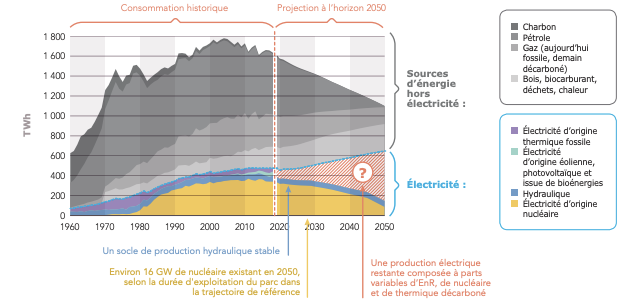
An op-ed I am publishing today in the newspaper “alternatives économiques” following the publication of RTE’s scenarios for our future energy mixes out to 2050. My main messages: (1) the real constraint is not economic but rather about the pace of deployment, for every technology. (2) EPR2 reactors must be launched right now, and we should hold ourselves to the N1 pace for renewables until 2035: 3 GW/year of solar PV, 1 GW/year of offshore wind, and a little over 1 GW/year of onshore wind. (3) By 2035 we will then have both the evidence and the freedom to choose between N1, N2 and N03 (and the re-industrialisation variant). (4) This is not a battle in which one vision must win by crushing another; above all we need to build a society around a shared project. The electricity transmission system operator RTE published today its study of the alternatives for our future energy system [RTE-25-10-2021]. Under the objective of carbon neutrality in 2050, electricity — only a quarter of our final energy consumption today — will account for 55% of it. New, less carbon-intensive uses will take their place: electric vehicles, hydrogen production for industry, and heat pumps. The efficiency of these systems, combined with sufficiency measures, will make it possible to almost halve final energy consumption, while electricity consumption, today around 450 TWh/year, could then rise to 650 TWh/year.
This study, which focuses on the power system, does not arrive today by chance: these new uses of electricity and the ageing of the nuclear fleet — low-carbon though it is — call for strong decisions. Built almost entirely between 1975 and 1990, the fleet now has an average age of 35 years, and nobody can say which lifetime extensions will be possible without problems beyond 50 or even 60 years. Closing a profitable low-carbon plant too early is problematic, but failing to anticipate a replacement need sufficiently is even worse. All the more so since, even setting aside the particular causes of the Flamanville failure, it must be acknowledged that our industrial capacity to build is no longer that of the 1970s, and that part of the nuclear industry will be rather busy in the coming years operating and refurbishing the current fleet.
Even if decisions are taken today, apart from Flamanville no new EPR will be connected to the grid before 2035. In the longer term, if a 60-year extension is possible for some plants, one can envisage replacing all 63 GW. That is the equivalent of 40 EPRs, but there could be SMRs around 2040 if these small reactors live up to their promise. Such a complete renewal of the fleet implies construction and closure rates that must be examined carefully. In such a scenario, we would in the long run have a little more than half of our electricity produced from nuclear instead of three quarters today. The remaining half would come mainly from renewable energy, which nonetheless implies substantial development — starting now, to support the growth of electricity consumption — with a doubling of the rate of solar PV installation and the maintenance of the current wind rate. Let the self-proclaimed experts in gratuitous opposition to renewables explain to us, with calculations as precise as RTE’s, how they manage without it. An alternative to this 50/50 scenario is to have less nuclear and more renewables. Note that depending on the share taken by variable renewables, they must be complemented by more or less flexibility: generation from renewable gas (hydrogen or biogas), storage, demand-side management and interconnections, so that everyone is sure to have electricity on a cold winter night in the middle of a few windless days. That is precisely the kind of analysis RTE performs, with very advanced methods, over hundreds of weather scenarios, taking climate change effects into account. The study also includes a costing of the network. RTE is responsible for system balance and, to say the least, it is not in the habit of taking positions without measuring the risks involved as precisely as possible.
To analyse these alternatives out to 2050, six scenarios are considered. The common denominator of the first three, N1, N2 and N03, is the construction of new EPRs (by 2050: 8 in N1 and 14 plus a few SMRs in N03), and an extension of the current fleet to 2050 (15 reactors in N1 and 20 in N03). Scenario N03, the most ambitious for nuclear, targets 50 GW of nuclear in the long run and should make it possible to keep nuclear’s share of the electricity mix at 50%, with a deployment rate that intensifies in 2040 to 2 GW/year. EDF presents it as an upper bound on what can be asked of the nuclear industry. In the other three scenarios, the “M” ones, no EPRs are built and only renewables are added, while the nuclear fleet is extended (15 reactors in 2050 in M23) — except in M0. In that last case, the most committed of the 100% renewable scenarios, the average deployment rate must be multiplied by seven for solar PV and by two for onshore wind. Given the acceptability difficulties we face today, suffice it to say that these rates are bold, and that relying on them may even be risky.
Beyond demonstrating the technical feasibility of all these scenarios, the results of the study allow an estimate of the economic and environmental cost of each of them. On the environmental side, all these scenarios are compatible with carbon neutrality, with very low emissions. The environmental analysis does not stop there: it also covers the materials used, the waste, and so on. All the scenarios mentioned have relatively similar economic costs, of the order of €60–80 billion per year on average, against €45 billion today. Related to the volume that will be consumed — which will also increase — that gives electricity at about €110/MWh excluding taxes in 2060, against €100/MWh today. That increase is small compared with what we will save by bringing our crude oil and natural gas consumption to zero, which cost us around €35 billion of imports in 2019. The most renewables-committed scenario is 15% more expensive than scenario N1, which is itself 10% more expensive than N03 at €59 billion. These differences are not large given the uncertainties on the assumed future costs of each technology. Rather, they should make us understand that the question is not so much economic as political and environmental.
The real constraint on every sector is the pace of deployment. In that sense, given the importance of the nuclear industry in the French economic, industrial and social landscape, it seems right to me to relaunch nuclear with a few EPR2s, so as to keep the N scenarios within our reach. That said, settling for the N03 level of renewables deployment risks closing the door on N1 and N2, and N03 rests on some bets that we will not settle any time soon: extending the historical fleet beyond 60 years, and a commissioning rate of 2 GW/year from 2040. So out to 2035 we must relaunch the first six or eight EPR2s and hold ourselves to the N1 deployment rate for renewables: 3 GW/year of solar PV, 1 GW/year of offshore wind, and a little over 1 GW/year of onshore wind. That is roughly what the PPE contains, and it leads to 50% renewables in the electricity mix by 2035. If in 2035 we observe that the EPR2 projects are finishing on time and at the announced cost, if some of the current nuclear plants can indeed be extended, and if SMRs live up to their promise, then the French will be able to choose to slow the pace of renewables deployment in favour of nuclear with N03.
There is nothing really surprising or radically new in the broad lines of these results. Nothing that, in orders of magnitude, has not already been said earlier by experts in the field. What is radically new is above all the fact that the French transmission system operator RTE is the main author of the calculations — but also the method used. On one side, that method mobilised whole teams at RTE and external experts on advanced calculations over several years. On the other, a large-scale public consultation was set up, from the beginning to the end of the project, to discuss the assumptions, the chosen scenarios and the methods used. It involved every stakeholder in the field: politicians and government departments, industry, associations and more generally civil society.
One may hope that this study brings some calm to a debate in which the dishonesty and simplism of the detractors of variable renewables have taken up far more space than rigorous scientific analysis. The result today is a loss of bearings on these questions and the disappearance of enthusiasm for a necessary transition. That reversal is unfortunately being exploited in the presidential debate by some politicians who are oblivious to the realities RTE sets out for us. Let us hope that this study makes it possible to move beyond the sterile and simplistic divides that have become commonplace and that are costing us precious time and energy. What we need is not for one camp to win against another, but to build a society around a clear and coherent project that gives everyone their place.