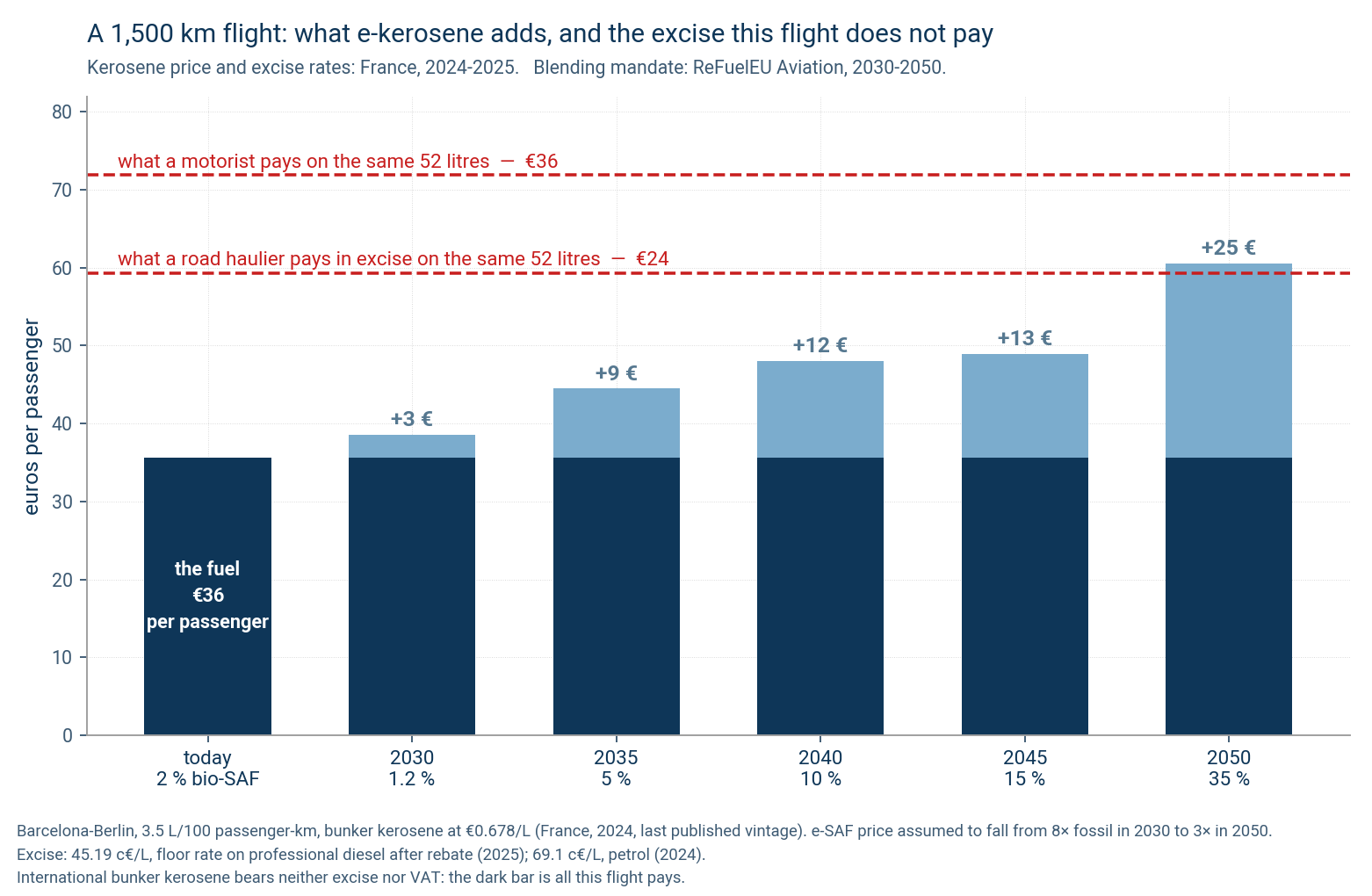
Three vintages coexist and must be kept apart: the kerosene price and the petrol excise are 2024, the professional-diesel floor rate 2025, the oil shock 2026, and the blending rates run from 2030 to 2050. The 2024 price serves as a benchmark, not as a current price: in 2026 kerosene is far more expensive, which does not change the ratio between the e-SAF surcharge and the excise, both proportional to volume.
The text of the post
Hormuz is pushing the price of kerosene up again, and the head of Transavia France is seriously worried about the viability of his company’s business model.
IATA’s 2026 figures for aviation as a whole illustrate his problem well: while the industry’s fuel consumption held steady at around 315 Mt, jet fuel went from 90 to 152 dollars a barrel. Fortunately for them, these companies do not buy all their volumes on the short-term market, but the bill still climbed from 252 to 350 billion dollars. Fuel thus goes from 25 % to 31 % of costs.
Airlines passed about 70 % of the shock on to prices and took the rest out of their margins. Capacity offered also stopped growing. And demand did not blink: 2.4 % more passengers, a record load factor of 84 %, this summer in Europe. What gave way was the bottom line: 45 billion dollars of net profit in 2025, 23 expected in 2026. Net profit per passenger falls from 9.10 to 4.50 dollars.
Today, synthetic fuel projects appear to be emerging in Europe at interstellar abatement costs — of the order of 1,500 €/tCO2. We are told these developments are justified, compared with other decarbonisation actions such as steel or ammonia, which we decarbonise at 150 €/t, because the customers can pay. Obviously the gradual blending rates will smooth the path, but the aviation industry will not be able to simply absorb rising prices in its margins: ticket prices will have to go up.
E-fuel today is 10 times the price of fossil kerosene before Hormuz, and fuel costs rose 39 % this year; if e-SAF comes down to three times the fossil price, it is clear that the price rise will bring demand down. With the elasticities estimated for today’s world — and assuming e-SAF falls to 3 times the current fossil price — that could mean a drop of 10 to 25 % in 2050, bearing in mind that the European mandate jumps quite sharply between 2045 and 2050.
A small graphical illustration to support all this. The figure takes a 1,500 km flight. Fuel there costs 36 euros per passenger; the e-SAF mandate adds 3 euros in 2030 and 25 in 2050. On the same 52 litres, a road haulier would pay 24 euros of excise, a motorist 36. The passenger pays nothing: international bunker kerosene bears neither excise nor VAT. One may find the cost increase brought by e-SAF indecent; one may also note that if this obligation is seen as a tax, it amounts to no more than the taxes motorists already pay.
Sources: IATA (Global Outlook, June 2026, tables 9 and 12), Eurocontrol, Eurostat, ICCT, Transport & Environment, Regulation (EU) 2023/2405. Everything is at https://www.energy-alternatives.eu/en/linkedin.html
Sources
- AFP / Connaissance des Énergies, « Quasi impossible d’être rentable avec un kérosène aussi cher », 15 septembre 2026
- IATA, Global Outlook for Air Transport — Energy in Crisis, juin 2026 : Table 9 (métriques carburant) et Table 12 (statistiques industrie)
- IATA, Jet Fuel Price Monitor
- EIA, U.S. Gulf Coast Kerosene-Type Jet Fuel Spot Price FOB (série mensuelle)
- Eurocontrol, trafic aérien du réseau européen, été 2026
- Eurostat, indice des prix à la consommation harmonisé — transport aérien de passagers (prc_hicp_aind, CP0733)
- Eurostat, transport aérien de passagers par pays (avia_paoc)
- Règlement (UE) 2023/2405 (ReFuelEU Aviation) — taux d’incorporation de SAF et sous-mandat e-SAF
- Transport & Environment, Why airlines’ complaints about ReFuelEU don’t add up, mars 2026
- ICCT, Current and future cost of e-kerosene in the United States and Europe, mars 2022
- Future costs of power-to-liquid sustainable aviation fuels, Sustainable Energy & Fuels 8(4), 2024
- Brons, Pels, Nijkamp & Rietveld, Price elasticities of demand for passenger air travel: a meta-analysis, JATM 8(3), 2002
- InterVISTAS pour IATA, Estimating Air Travel Demand Elasticities, 2007
- Price Elasticities in Aviation: Novel Estimates from Structural Gravity Modelling and Instrumental Variables, Transportation Research Procedia, janvier 2026
- Directive 2003/96/CE, art. 14(1)(b) — exonération du carburant de l’aviation commerciale
- CNR, actualité de l’accise sur le gazole — taux plancher du gazole professionnel
Code
The code that produces the figure is in the public repository linkedinposts, folder efuels_aviation.
The script build_billet.py produces the figure on its own.
To reproduce the figure:
cd efuels_aviation
python3 build_billet.py            # les deux langues
python3 build_billet.py --lang fr  # une seule
The script reads no input file: every assumption sits in commented constants at the top, with its unit and its vintage. The e-SAF / fossil kerosene price ratio, from ×8 in 2030 to ×3 in 2050, is the figure’s only free assumption.
All files of this post (figures, data, scripts) are in the folder 2026-09-16-efuels-prix-du-billet of the public repository.
Code under the MIT licence; texts and figures under CC BY 4.0; data remain under their producer’s licence.