The figures quoted in this post are sourced in the folder’s
sources.md: that is where the values, their units and their vintages live — not on the image.
The text of the post
ArcelorMittal walked away from 1.3 billion euros of German public subsidies. That alone tells you the main obstacle to the direct reduction of iron ore with hydrogen is not the capital cost. It is the price of carbon, too low, and the price of low-carbon hydrogen, too high. But is that all it is?
June 2025: ArcelorMittal cancels its two German projects, Bremen and Eisenhüttenstadt, and leaves the 1.3 billion on the table. “Even with the financial support, the business model is not viable.” February 2026, Dunkirk: the same amount is invested, but in a 2-million-tonne electric arc furnace for 2029, and the hydrogen project is suspended. Thyssenkrupp is indeed building its direct reduction shaft in Duisburg, but will run it on methane, and has paused its green hydrogen tender for lack of an acceptable price.
None of these companies has given up on decarbonising. They have arbitraged. The electric arc furnace for recycling is the cheapest building block, and nothing obliges them to go further — but recycling cannot cover everything.
For hydrogen, the hope remains that e-fuels and ammonia will carry its growth. With one option for Europe, or one risk: that they get made where the wind and the sun are. In Saudi Arabia, NEOM is commissioning 2.2 GW of electrolysers on 4 GW of solar and wind: up to 1.2 million tonnes of green ammonia a year, first product in 2027, and built for export. The abatement cost of steel reduced with green hydrogen is between 200 and 300 euros per tonne of CO2 depending on where the hydrogen comes from, which is, on a new car at 36,000 euros, less than 500 euros to add. At a time when we are funding e-fuels at more than 1,500 euros a tonne, European strategy and our regulations raise questions.
But perhaps Arcelor has drawn a line under hydrogen for another reason? Because another route is moving: the direct electrolysis of iron ore. SIDERWIN, the European project, has become Volteron with John Cockerill: a pilot has been running since 2025, and a first plant of 40,000 to 80,000 tonnes of iron plates is targeted for 2027. Electrolysis skips hydrogen: from electricity to iron, one conversion instead of two.
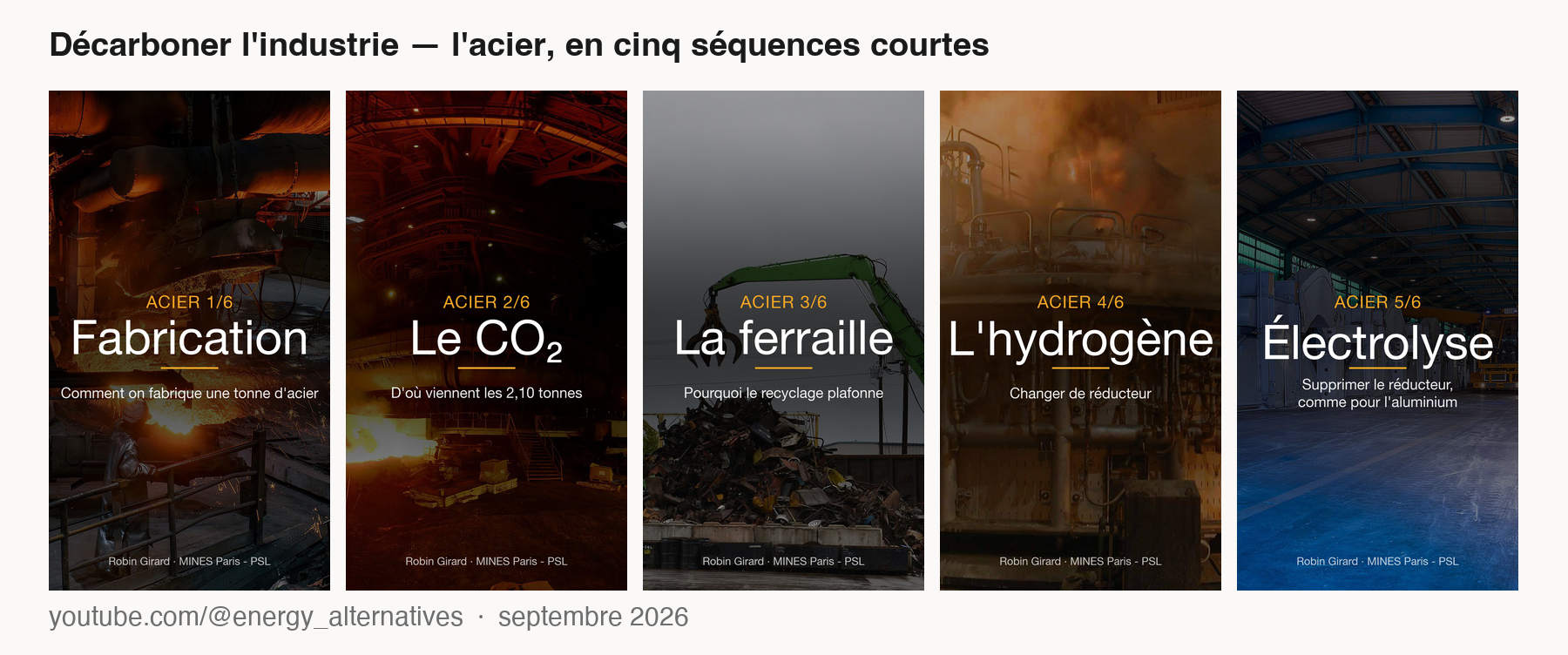
This is the subject of the videos on my small YouTube channel. It is very much homemade, but it gathers short-format teaching content. The first five are online, on steel, from making it to electrolysis — how a plant works, and how you transform it. The one on hydrogen shows the furnace that is already running: 140 million tonnes of direct reduced iron in 2024, 7 % of world steel, two thirds of it on natural gas.
Sources: ArcelorMittal, thyssenkrupp Steel, John Cockerill, NEOM Green Hydrogen Company, Midrex. The videos: youtube.com/@energy_alternatives
Two wordings made precise relative to the post
- “between 200 and 300 €/tonne” is an abatement cost, hence euros per tonne of CO2 avoided, not per tonne of steel. That is what makes the rest consistent: 200 to 300 €/tCO2 × 1.37 tCO2 avoided per tonne of steel × 0.8 tonne of steel per car gives 220 to 330 euros per car, comfortably “less than 500 euros”.
- France Stratégie declines to give a single number for direct reduction using hydrogen produced in France — the result depends too heavily on the hydrogen price assumed. The 200 to 300 €/tCO2 range brackets the report’s costed routes and the imported-hydrogen case; it is not a row of the table but a reading range.
Sources
- ArcelorMittal annule ses deux projets allemands de réduction directe à l’hydrogène malgré 1,3 Md€ de subventions — Hydrogen Insight, juin 2025
- ArcelorMittal confirme la construction d’un four électrique à Dunkerque — ArcelorMittal France, février 2026
- ArcelorMittal confirme un investissement de 1,3 milliard d’euros à Dunkerque pour un four électrique — Le Journal des Entreprises
- Hydrogène vert : le projet d’H2V à Dunkerque est en suspens — Le Journal des Entreprises
- thyssenkrupp Steel, stratégie climat — la cuve de réduction directe de Duisbourg démarre au gaz naturel
- thyssenkrupp Steel suspend son appel d’offres d’hydrogène vert faute de prix acceptable — Eurometal
- ArcelorMittal et John Cockerill : première usine industrielle d’électrolyse du fer à basse température (Volteron, ex-SIDERWIN)
- NEOM Green Hydrogen Company — 2,2 GW d’électrolyse, 4 GW de solaire et d’éolien, jusqu’à 1,2 Mt/an d’ammoniac vert
- ACWA Power, fiche du projet NEOM Green Hydrogen — 600 t/j d’hydrogène, premier produit en 2027
- Midrex, World Direct Reduction Statistics 2024 — 140,8 Mt de fer préréduit, dont ≈ 68 % en fours à cuve au gaz naturel
- Reels « acier » — la chaîne YouTube dont le post annonce les cinq premiers épisodes
Code
The script build_figure.py produces the figure on its own.
To reproduce the figure:
python3 build_figure.py # figure_chaine_fr.png, 1800×752
The script reads no data file: it rebuilds the strip from the five reel covers (energy-alternatives/assets/reels/acier_N.jpg), in order 1 → 5, on an opaque background, with the channel address and the vintage printed on it. That is what separates this image from a screenshot: it can be regenerated identically.
All files of this post (figures, data, scripts) are in the folder 2026-09-17-hydrogene-dri-en-question of the public repository.
Code under the MIT licence; texts and figures under CC BY 4.0; data remain under their producer’s licence.