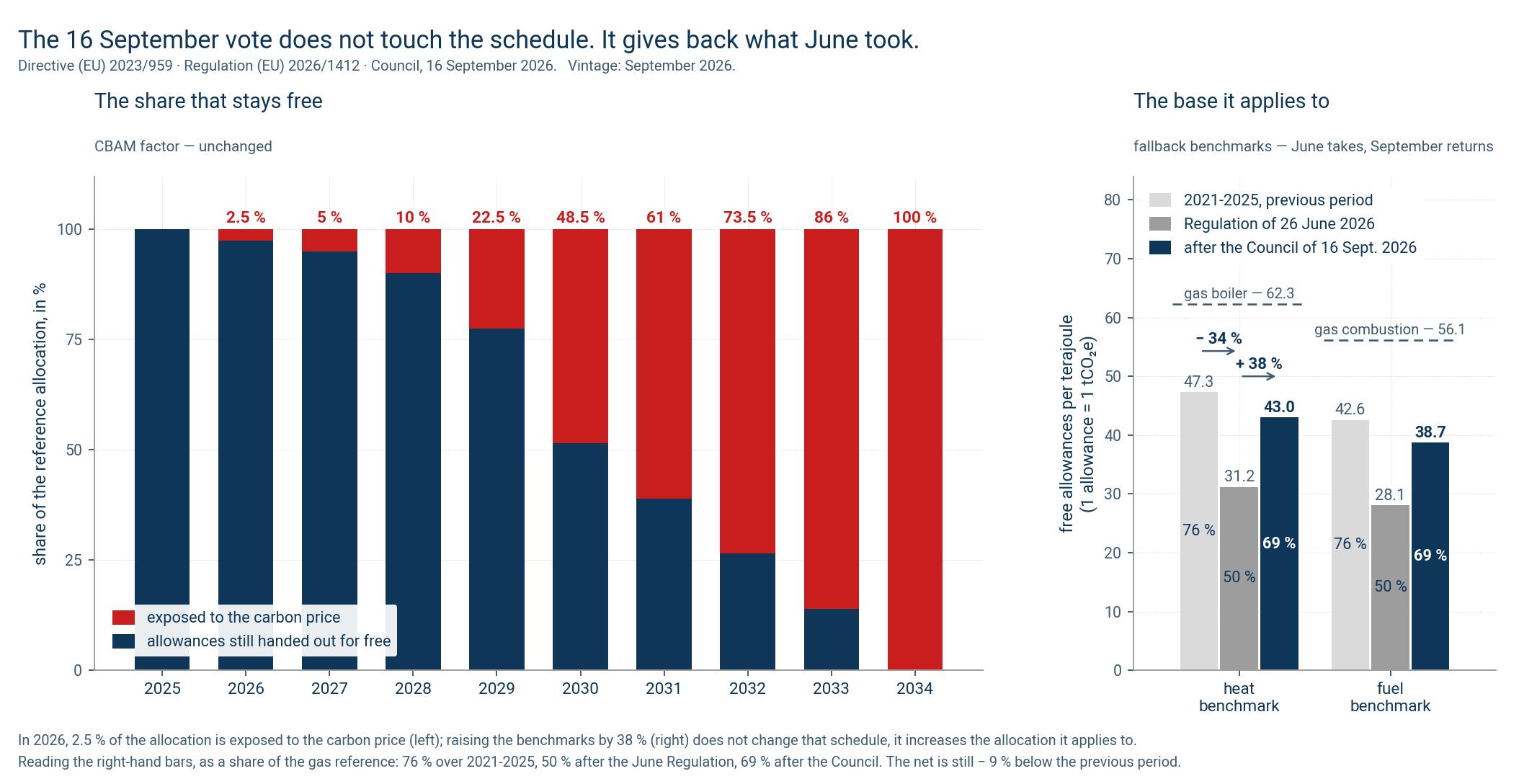
The two texts of 15 and 16 September 2026 are negotiating positions, not law: the trilogue, formal adoption, publication in the Official Journal and then the implementing acts all remain. Nothing voted that week applies before 2027 at the earliest, and the CBAM extension to downstream products is set for 1 January 2028.
The text of the post
If you have seen the series Parliament, you have a sense of the European tempo: an amendment there takes four seasons to come into being. Last week, Europe did two things in two days. On Tuesday, Parliament tightened the carbon border tax. On Wednesday, the Council handed six billion euros of free allowances back to industry.
On 15 September, MEPs extended CBAM to some 180 processed steel and aluminium products: screws, springs, household goods. It is common sense, even if it only applies from 2028, when CBAM still claims no more than 10 % of the carbon price: a few tens of millions of euros in the first year. The impact assessment expects almost no direct emission reductions from it — under one million tonnes of CO2 a year by 2035, against 34.6 for CBAM itself. Its purpose lies elsewhere: to stop production leaking out of Europe. The downstream leakage rate would fall from 60 % to 20 %.
On 16 September, the Council made the other move, and here you have to keep up. On 26 June, the Commission published a regulation cutting by a third the free allocation of a whole swathe of industry: chemicals, paper, ceramics, food processing, and those parts of steel and cement sites that have no product benchmark — while announcing in the preamble of that same text that it would propose a correction. Three weeks later it arrived, and on 16 September the Council approved it: the allocation goes back up without regaining its earlier level.
Concretely, an allowance is indeed one tonne of CO2, and a site’s emissions are measured and verified. What is conventional is the number of allowances it is given for free: that is computed on its activity — here the terajoules of heat consumed — and not on what it emits. It is this benchmark value that changed: the allocation goes from half to two thirds of what a gas boiler emits to produce a terajoule of heat. For an installation heating with gas, the 2026 carbon bill falls from 2,600 to 1,700 euros per terajoule.
Free allocation is simple to compute:
free allocation = benchmark value × activity level × CBAM factor
In the chart, the CBAM factor on the left, the benchmark on the right.
But are allowances the only instrument? The French cement industry is moving, not because of the carbon price but because of RE2020, which caps embodied carbon per square metre in new buildings. For steel, a demand-side rule exists in embryo at European level: the low-carbon steel credits in the 2025 automotive package — but it does not act as a real constraint.
None of this is law yet: the trilogue, formal adoption, the Official Journal and the implementing acts all remain. We really are in the series.
Sources: European Parliament, Council of the EU, impact assessment SWD(2025) 988, Regulation (EU) 2026/1412, Directive (EU) 2023/959, Commission benchmark factsheets.
Sources
- Parlement européen, Strengthening the EU carbon border adjustment mechanism and closing loopholes, 15 septembre 2026
- Conseil de l’UE, ETS: Council agrees targeted measure to protect energy-intensive sectors from carbon leakage, 16 septembre 2026
- AFP / Connaissance des Énergies, Les eurodéputés votent pour élargir la taxe carbone aux frontières, 15 septembre 2026
- Directive (UE) 2023/959 — le facteur MACF, art. 10 bis §1 bis de la directive 2003/87/CE
- Règlement (UE) 2023/956 établissant le mécanisme d’ajustement carbone aux frontières
- Commission européenne, Carbon Border Adjustment Mechanism — régime définitif depuis le 1er janvier 2026
- Commission européenne, SWD(2025) 988 final — étude d’impact de l’extension du MACF aux produits en aval, 17 décembre 2025
- Commission européenne (DG CLIMA), Update of benchmark values for 2021-2025 — fiches accompagnant le règlement d’exécution (UE) 2021/447
- Règlement d’exécution (UE) 2026/1412 du 26 juin 2026, valeurs révisées des référentiels pour 2026-2030
- France Stratégie, Les coûts d’abattement — Partie 7 : Acier, octobre 2024
Code
The script build_figure_v2.py produces the figure on its own.
To reproduce the figure:
python3 build_figure_v2.py            # les deux langues
python3 build_figure_v2.py --lang fr
The script reads no data file. Its two series are copied from their texts and quoted in the header: the CBAM factor, from Directive (EU) 2023/959, and the three vintages of fallback benchmarks — 47.3 and 42.6 for 2021-2025 (DG CLIMA factsheets), 31.2 and 28.1 (Regulation of 26 June 2026), 43.0 and 38.7 (Council mandate of 16 September 2026). That is why no CSV is attached. Two further scripts accompany the post without producing a chart: estimation_elargissement.py, which sizes the extension, and pedagogie_referentiel.py, which translates a benchmark into euros per terajoule.
All files of this post (figures, data, scripts) are in the folder 2026-09-22-macf-le-signal-et-la-regle of the public repository.
Code under the MIT licence; texts and figures under CC BY 4.0; data remain under their producer’s licence.